AI Podcasts for Japanese Business Associations in the U.S.
How Japanese business associations in the U.S. turn member newsletters and event briefings into recurring audio that busy professionals absorb.
I like this use case because it is not trying to force a podcast onto an audience that does not need one.
Japanese business associations in the U.S. already have a communication rhythm:
- newsletters
- event invitations
- market updates
- member briefings
- policy summaries
The problem is usually not "what should we say?"
The problem is that busy members do not always read everything in full.
That is where I think AI podcasts can help. Not as a branding exercise. As a better way to package recurring briefings for people who are already overloaded with information.
Why This Use Case Makes Sense
Associations already sit on structured, recurring, explanation-heavy content that adapts naturally to audio — the barrier is not content creation but content consumption. I have spent enough years around business communication to know that the issue is often not quality. It is consumption.
The memo is fine.
The newsletter is fine.
The event update is fine.
But if the audience is a group of already-busy professionals, "fine" often means "skimmed at best."
That is why I think this use case is strong. Associations already sit on structured, recurring, explanation-heavy content that can adapt well to audio.
What Fits Audio Best?
Usually, the best candidates are the things members want to understand quickly without opening another long document.
| Content type | Why it works in audio |
|---|---|
| Event briefings | Easy to absorb before attending |
| Policy summaries | Good for explanation and context |
| Member newsletters | Better when reduced to key points |
| Market roundups | Strong fit for recurring briefings |
| Executive updates | Useful for tone and framing |
| Cross-border business notes | Easier to follow conversationally |
Usually weaker fits:
- spreadsheets
- legal text that requires line-by-line review
- highly visual decks
- detailed tables people need to reference later
So no, I would not turn every association document into a podcast.
I would start with the updates members are supposed to understand, remember, and maybe act on.
Why Audio Instead of Just Sending Another Newsletter?
Adding one more written update to an already-overloaded inbox does not improve communication — it just adds to the pile. Because business audiences are just as overloaded as everyone else, maybe more.
They already have:
- Slack
- Teams
- calendars
- internal memos
- external newsletters
Adding one more written update does not automatically improve communication.
Audio gives associations another format for:
- commute time
- airport time
- walking between meetings
- catching up without opening a laptop
That does not replace the written version. It just makes the update easier to consume in real life.
What Would I Actually Launch First?
I would start with one recurring briefing format.
Not a grand "association media strategy." Just one thing that solves one real communication problem.
For example:
- a weekly member briefing
- a monthly market update
- an event-prep audio summary
- a leadership update before a major conference
If that works, then you can expand.
If that does not work, you stop early and learn something. Less is more.
What Does the Workflow Look Like?
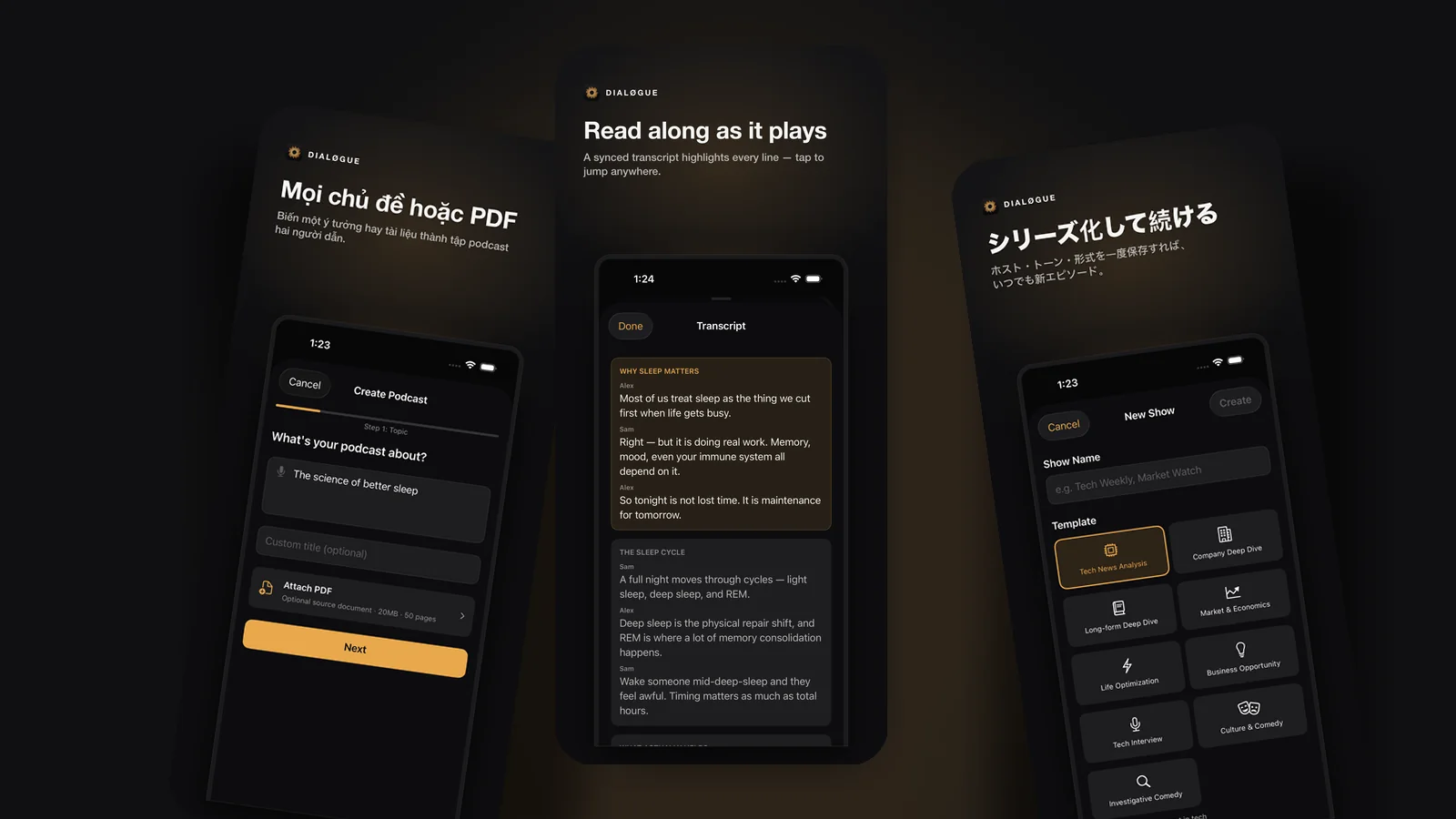
This is where I think DIALØGUE fits better than a simple voice generator.
1. Start from the real source material
Use the actual association content:
- a newsletter
- a briefing memo
- an event guide
- a policy summary
- a PDF deck
If it already exists, upload it as a PDF or use the topic plus document workflow.
I prefer that because business communication tends to get vague very quickly when people recreate it from memory.
2. Review the outline first
This is one of the more important parts of the workflow.
Before any final audio is generated, the association can check:
- are we focusing on the right priorities?
- is the briefing too broad?
- are we missing context members actually care about?
- does the episode sound like a useful update or just a generic summary?
That outline review is what keeps the workflow from becoming lazy automation.
3. Review the script before voice generation
This is the second control point, and for associations I think it matters even more. If you have a member newsletter or briefing memo ready to test, try the workflow here — both review gates happen before final audio.
A script can be technically correct and still be wrong in a business context because:
- the emphasis is off
- the tone is too casual
- a sensitive issue is phrased poorly
- the update loses the nuance members actually need
That is why I like the script review gate. It gives you one more chance to make the message sound like it came from a serious organization, not a random content machine.
4. Turn it into a Studio show only if the first version is useful
This is where I would stay pragmatic.
If one briefing works, then Studio show workflows start to make sense.
If the first one does not feel useful, do not force it into a bigger program just because "podcast strategy" sounds modern.
Who Is This Best For?
I think this is strongest for:
- Japanese business associations with regular member updates
- chambers or member organizations running recurring events
- cross-border groups sharing policy or market context
- associations that already write too much and want a lighter delivery format
It is especially useful when the organization already has content discipline but needs better distribution, not more ideas.
When Would I Not Push This?
I would be cautious when:
- the content is mostly reference material
- members need exact tables more than explanation
- the update is too sensitive for conversational packaging
- the audience already has a simpler format that works
Not every communication problem needs audio. Sometimes the right answer is still a short written summary and a link.
Why This Can Be More Than a One-Off
This is the part that interests me most.
Associations already operate on cadence:
- monthly
- quarterly
- event-driven
- issue-driven
That means the workflow can become repeatable if the first version is good enough.
And repeatability is where content stops being a demo and starts being useful.
That is why I think this use case sits naturally next to AI podcasts for sales enablement, podcasts for business, and can you create a podcast in multiple languages. For the broader business use case, the podcasts for business guide covers the wider picture.
Where This Fits in the Cluster
I think of this as the institutional and member-briefing edge of the mini cluster.
If your use case is more school-based, start with AI podcasts for Japanese supplementary schools in the U.S..
If your use case is more community and family-facing, read AI podcasts for Korean American community organizations.
If you need the repeatable workflow layer, pair this with the Studio show workflow guide.
My Short Version
The associations that will get the most out of this are the ones where the newsletter already works — it just does not get read enough.
Audio does not fix a bad message. It does not fix a boring update. What it can do is give a good briefing one more chance to reach the people who meant to read it and did not.
Start with one member update. See if consumption improves. If it does, you have a repeatable briefing workflow. If it does not, you spent one credit and learned something about what your members actually want.
If your association already has newsletters, event guides, or member briefings sitting in PDF form, start with one update and see if the audio version is easier to keep up with. For the rest of this cluster, read AI podcasts for Japanese supplementary schools in the U.S., AI podcasts for Korean American community organizations, the Studio show workflow guide, and podcast from PDF.
Written by
Chandler NguyenAd exec turned AI builder. Full-stack engineer behind DIALØGUE and other production AI platforms. 18 years in tech, 4 books, still learning.
Related Articles

Ready to create your own podcast?
Turn any topic or document into a professional podcast — with outline and script review before audio.
Create a Podcast