Can You Create a Podcast in Multiple Languages?
Yes, but the real question is how. A practical guide to multilingual podcast creation, what changes between languages, and why repeatable publishing matters more than a language toggle.
Yes, you can create a podcast in multiple languages.
But I think that answer is too shallow on its own.
The more useful answer is this: yes, but good multilingual podcasting is not just translation. It is a workflow problem. The real test is whether the episode works naturally in the target language, whether the voices fit, and whether the publishing process holds up more than once.
That distinction matters a lot more than it sounds.
What Does Multilingual Podcast Creation Actually Mean?
At the simplest level, it means the same content idea can be produced in different languages.
In practice, though, a good multilingual workflow usually needs:
- language-aware script generation
- voice options that fit the language
- accent and pacing control
- audience-aware phrasing
- packaging that works in each language
That is why I do not think "supports multiple languages" is enough as a product claim by itself.
Is This Just Translation?
No, not if you care about quality.
Translation is one piece of the problem. But multilingual podcast creation also involves:
- whether the dialogue sounds natural
- whether the host style feels believable
- whether the topic packaging makes sense for that audience
- whether the publishing workflow can be repeated
This is one reason I now talk about multilingual support more carefully. After working on the Vietnamese daily podcast demo and seeing more than 20 episodes get published, I stopped thinking of this as a checkbox feature.
For the case-study version of that lesson, see what we learned from publishing 20+ Vietnamese AI podcast episodes and how we built a daily AI podcast in Vietnamese.
What Does DIALØGUE Actually Support?
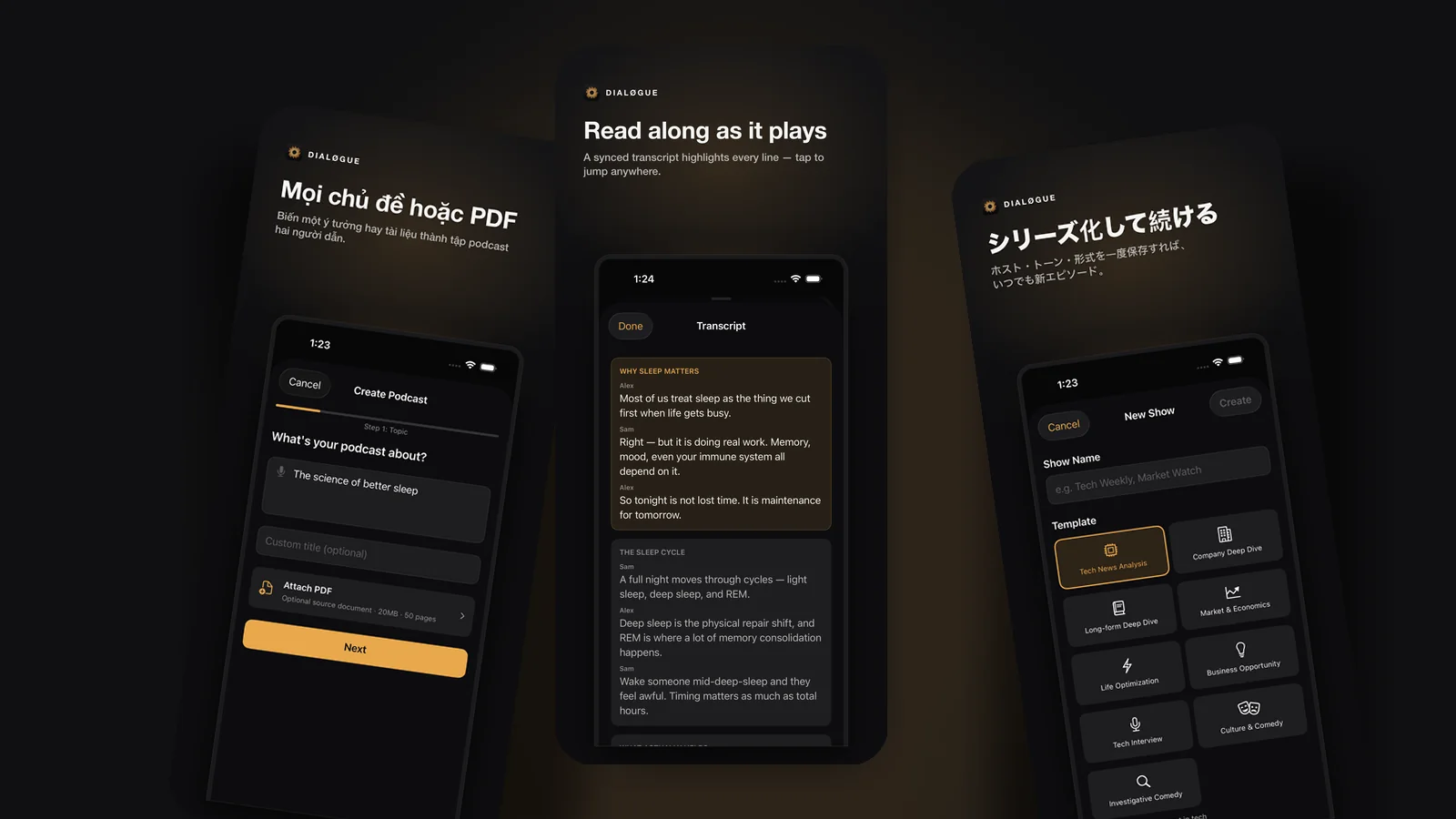
DIALØGUE currently supports 7 languages:
- English
- Vietnamese
- Japanese
- Korean
- Spanish
- Chinese
- French
What matters more than the count, though, is that the workflow is language-aware in multiple places:
- outline instructions
- dialogue generation
- final segment generation
- voice preview
- accent options
- recurring show configuration
That is the difference between "translated interface" and "multilingual generation workflow."
What Changes Between Languages?
More than people expect.
| Layer | Why it matters |
|---|---|
| Script phrasing | Direct translation can sound robotic |
| Host chemistry | Voice pairings do not feel the same in every language |
| Accent choice | Listener expectations differ |
| Pacing | Some languages tolerate density differently |
| Title packaging | What feels natural in one market may feel awkward in another |
| Publishing rhythm | Audience behavior may differ by language and market |
This is why language-specific voice preview and customization matter so much. A language is not just text. It is delivery.
If you want to go deeper on that delivery layer, voice customization is one of the more important pieces to get right.
What Makes a Multilingual Workflow Strong?
I think a strong workflow has four traits.
1. It supports native generation, not just surface translation
You want the system to generate content with language-aware instructions, not just produce one source script and flatten it later.
2. It lets you review before final audio
This is especially important in multilingual work because small phrasing problems can make an episode feel much less natural.
That is one reason I like the two review gates in DIALØGUE:
- outline review
- script review
They give you a chance to correct the direction before the final audio is locked in.
3. It supports voice and accent fit
If the voice feels wrong, the whole episode feels less credible even if the text is technically correct.
4. It can be repeated
This is the real bar.
One good demo is nice.
A repeatable workflow is a product.
That is also why Studio show workflows matter so much in multilingual workflows. They force the system to prove it can operate, not just impress.
Who Benefits Most from Multilingual Podcasts?
This is especially useful for:
- creators with audiences in more than one language
- educators reaching international learners
- companies with distributed teams
- marketers running region-specific content
- operators testing new markets with lower production overhead
If your audience is multilingual but your production process is not, this is where AI can change the economics quite a bit.
When Does Multilingual Podcasting Not Work Well?
I would be more cautious when:
- the content depends heavily on local cultural nuance you have not validated
- the host voice needs to feel deeply personal and human
- the source material is visually dense and already hard to adapt
- the language support exists technically but you have not tested actual publishability
That last one matters a lot. It is very easy to claim multilingual support. It is harder to prove it on a real channel.
My Practical Take
Yes, you can create a podcast in multiple languages.
The better question is whether your workflow treats multilingual output like:
- a translation layer
- or a real publishing system
I care much more about the second one now.
That is why features like language-aware voice preview, script review, Studio show workflows, and timezone-aware context matter. They make multilingual publishing feel operational instead of ornamental.
If you want the broad capability overview, read creating podcasts in multiple languages. If you want the more honest, operational version, start with how we built a daily AI podcast in Vietnamese. If you want to test the workflow directly, create a podcast in the target language and review the outline before you commit to full audio.
Written by
Chandler NguyenAd exec turned AI builder. Full-stack engineer behind DIALØGUE and other production AI platforms. 18 years in tech, 4 books, still learning.
Related Articles


Ready to create your own podcast?
Turn any topic or document into a professional podcast — with outline and script review before audio.
Create a Podcast