AI Podcasts for Business: Training, Collateral, and Internal Communications
How businesses use AI-generated podcasts for employee training, sales enablement, customer education, and internal communications — for both internal and external audiences.
Nobody reads the 40-page employee handbook. Or the quarterly update email. Or the product training deck.
We all know this. We send these documents anyway, telling ourselves that we've "communicated." But communication isn't about transmission — it's about consumption. And text-heavy internal communications have abysmal consumption rates.
Audio is different. People listen during commutes, workouts, lunch breaks, and downtime. They retain information better when it's conversational rather than formatted as bullet points. They engage with content they can consume hands-free.
The problem has always been production. Recording professional audio takes time, equipment, and skills most teams don't have. So companies default back to documents nobody reads.
DIALØGUE changes this equation. Any team member can create professional podcast content in minutes, without recording equipment, audio editing software, or production expertise. This isn't about making "another AI podcast" — it's about making internal communications and business content actually work.
How Can Businesses Use AI Podcasts Internally?
Employee Training & Onboarding
New hires face information overload: HR policies, benefits enrollment, systems access, company culture, role-specific training. It's typically delivered as a stack of PDFs and a week of meetings.
What if instead, you converted those materials into a series of podcast episodes?
Upload your training manuals and standard operating procedures as PDFs. DIALØGUE extracts the content and generates conversational podcast episodes that explain the material in an engaging format. Set content depth to "Beginner" for introductory content. Customize the host to sound like your company's training manager or a knowledgeable colleague.
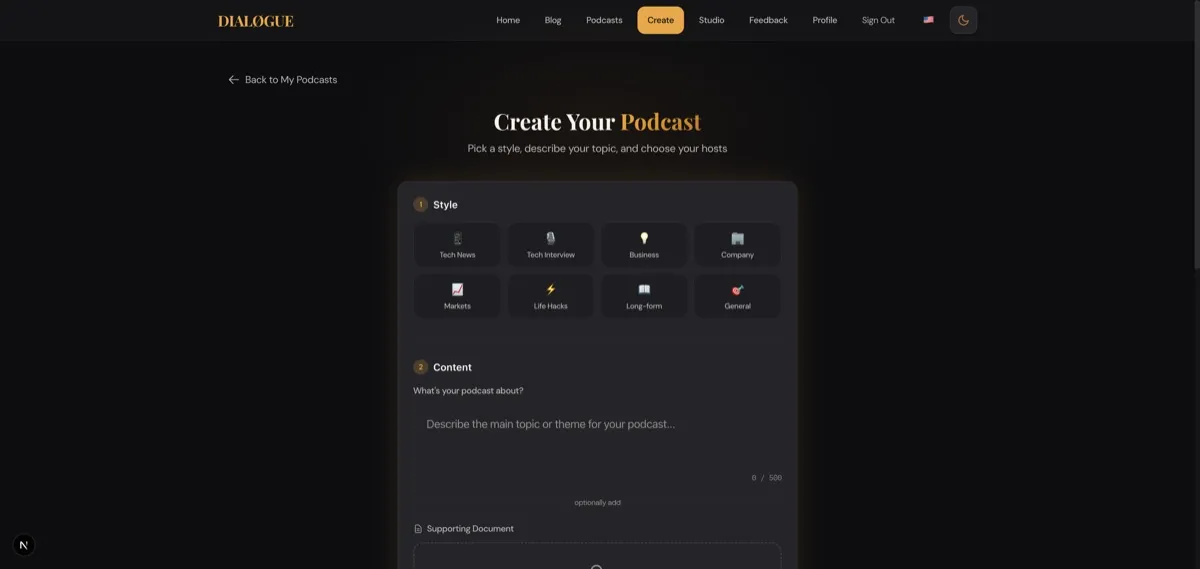
New hires can listen during their commute, take notes while listening, and replay sections they didn't absorb the first time. Completion rates go up. Retention improves. Onboarding becomes less overwhelming.
You can use the same approach for ongoing training: compliance updates, new product features, process changes, tool tutorials. Turn the 45-minute training webinar recording into a 15-minute podcast that people will actually consume.
For detailed instructions on converting documents to audio, see our guide on creating podcasts from PDFs.
See how AI podcasts work for your team. Create a business podcast episode in minutes — no production team required.
Company Updates & Town Halls
How many people fully read your CEO's quarterly update email? How engaged are employees during the all-hands Zoom call?
Transform company communications into podcast format. The CEO's message becomes a conversational episode that employees listen to on their own time. Instead of skimming an email, they hear the strategic vision explained naturally.
For repeatable company updates, set up a Studio show. Every quarter, month, or week, your team can drop in the latest company news, priorities, and announcements while keeping the same hosts, format, and approval flow.
It's more personal than email, more convenient than live meetings, and has significantly higher engagement rates.
Learn more about setting up Studio show workflows for your organization.
Compliance & Policy
Regulations. Safety procedures. Code of conduct. Anti-harassment training. Information security policies.
These topics are critical, mandatory, and universally dreaded. Not because the content isn't important — because the delivery is terrible.
Audio format doesn't make compliance fun, but it makes it less painful. A well-tuned podcast (Formality 80%, Humor 20%, Energy 50%) can present dry material in a way that employees actually pay attention to.
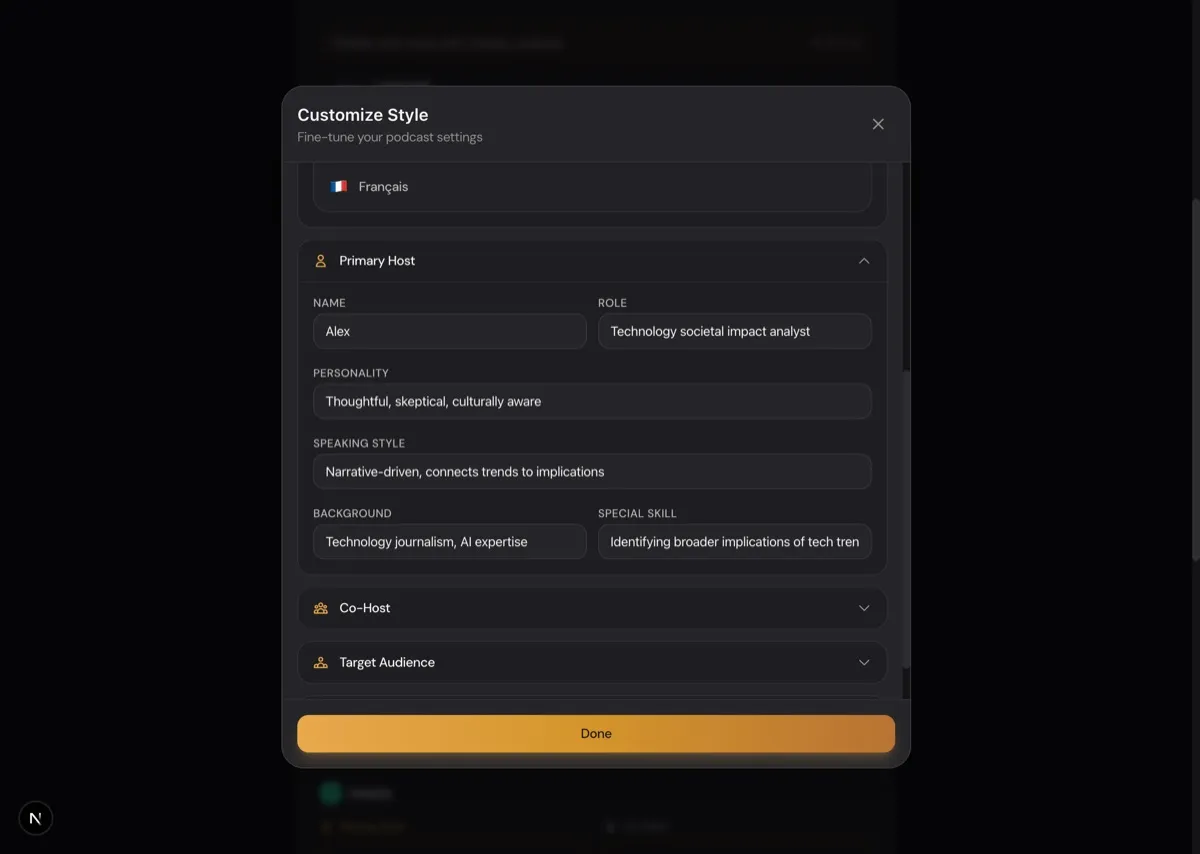
Upload your policy documents. Generate episodes that explain requirements, provide context for why policies exist, and walk through real scenarios. Employees complete their compliance training during their morning run instead of clicking through slides at their desk.
The completion tracking is the same. The comprehension is better. The experience is significantly less painful.
Knowledge Sharing
Every company has subject matter experts whose knowledge lives in their heads, email threads, or internal wiki pages nobody reads.
Turn that expertise into accessible audio. Upload research papers, internal documentation, postmortem reports, or technical deep-dives. The AI generates conversational explanations that make specialized knowledge available to broader teams.
A senior engineer's architecture decision document becomes a podcast explaining the technical tradeoffs. A product manager's market research report becomes an episode the entire company can understand. A legal team's explanation of new contract terms becomes something sales reps actually listen to.
How Can Businesses Use AI Podcasts for Customers?
Thought Leadership
Every company wants to be seen as an industry thought leader. Most attempt this through blog posts, whitepapers, and conference talks. But there's a massive audience that consumes information via podcasts.
Use Studio to set up repeatable show workflows. Weekly industry analysis. Monthly trend commentary. Quarterly deep-dives on your area of expertise. Position your executives as authoritative voices in your space.
The content is based on your actual expertise — market research, customer insights, technical innovations, industry trends. The delivery is professional, consistent, and distributed through standard podcast platforms.
Companies that establish podcasts as thought leadership channels build mindshare that blog posts alone don't achieve. Decision-makers are more likely to discover you, remember you, and trust you when they're ready to buy.
For strategies on building your brand through podcasting, check out our branded podcast strategy guide. You can also explore how podcasts fit into a broader SEO content strategy.
Customer Education
Support tickets, help center searches, onboarding questions — your customers need information. Most companies provide this through documentation, knowledge bases, and tutorial videos.
Add audio to that mix. Product tutorials as podcast episodes. Best practices guides as conversational walkthroughs. Use case stories as narrative explorations.
The customers who prefer audio format will have significantly better experiences. They'll need less support. They'll use your product more effectively. They'll become advocates faster.
Sales Enablement
Sales reps need constant updates: competitive landscape changes, new product features, market trends, customer success stories, objection handling techniques.
Traditional sales enablement relies on slide decks, email updates, and team meetings. Reps skim the slides, miss the meetings, and wing it on calls.
Create audio briefings instead. Competitive analysis podcasts they listen to before prospect calls. Product deep-dives they consume during their commute. Market trend episodes that prepare them for customer conversations.
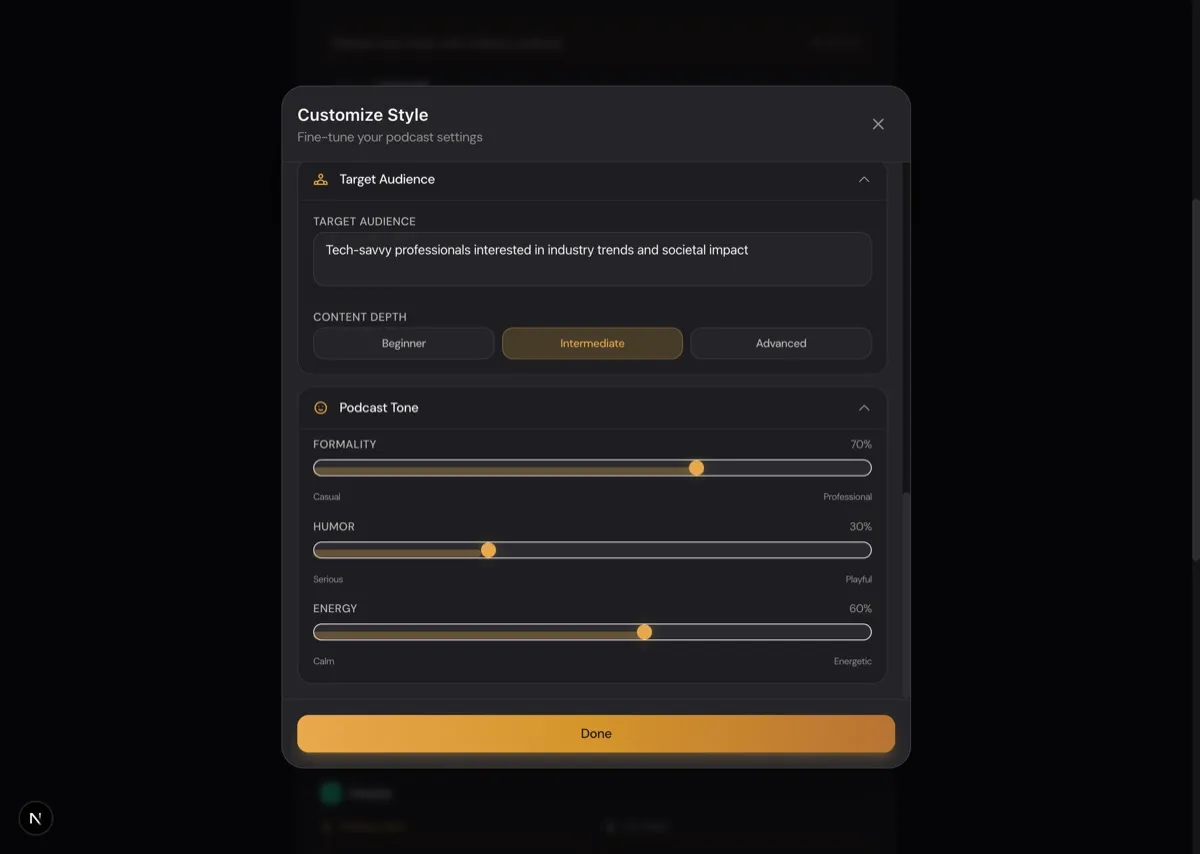
Customize the content depth based on your sales team's expertise level. Use the Company Analysis template for market positioning. Set the tone to match your sales culture — more energy for high-velocity sales teams, more measured formality for enterprise sales.
Sales reps who stay informed close more deals. Make staying informed convenient.
Marketing Collateral
You've invested in creating whitepapers, case studies, research reports, and industry analysis. Most of that content gets downloaded, skimmed, and forgotten.
Create podcast versions. The same content, delivered in audio format, reaches entirely different audience segments. Decision-makers who don't have time to read a 20-page whitepaper will listen to a 15-minute podcast about the same topic.
It's not replacing written content — it's extending your reach to audio-first audiences. For more on leveraging podcasts as a marketing channel, see our guide on AI podcasts for marketing.
Why DIALØGUE Works for Business
Most AI podcast tools are designed for content creators making entertainment. DIALØGUE was built for professional use cases where customization, control, and quality matter.
PDF Upload: Leverage Existing Content
You already have the content — training manuals, policy documents, whitepapers, reports, research. DIALØGUE extracts that content and transforms it into conversational audio.
You're not starting from scratch. You're repurposing what you've already created in a format that drives higher engagement.
See our detailed guide on creating podcasts from PDFs for step-by-step instructions.
Host Customization: Match Your Company Voice
Generic AI voices don't work for business content. You need hosts that sound like they belong to your organization.
Create hosts with specific expertise and personalities: "Sarah, VP of Engineering, who explains technical decisions in business terms." "Dr. Chen, Chief Medical Officer, who breaks down clinical research for patients." "Marcus, head of sales enablement, who speaks like he's briefing the team before a big call."
The host customization system lets you define name, role, personality, speaking style, background, and special skills. This level of detail creates audio that sounds professional and on-brand.
For more details on creating authentic hosts, see our AI voice customization guide.
Audience Targeting: Right Content for the Right People
The same information needs to be presented differently depending on who's listening. New hires need beginner-level explanations. Existing staff need intermediate detail. Specialists need advanced depth.
DIALØGUE lets you set content depth (Beginner, Intermediate, Advanced) and define your target audience in free-text ("software engineers who need regulatory compliance training but don't have legal backgrounds").
The AI adjusts the complexity, terminology, and assumed knowledge accordingly. One source document, multiple versions for different audiences.
7 Languages: Global Teams
Global companies need the same content in multiple languages. Creating translated versions manually is expensive and slow.
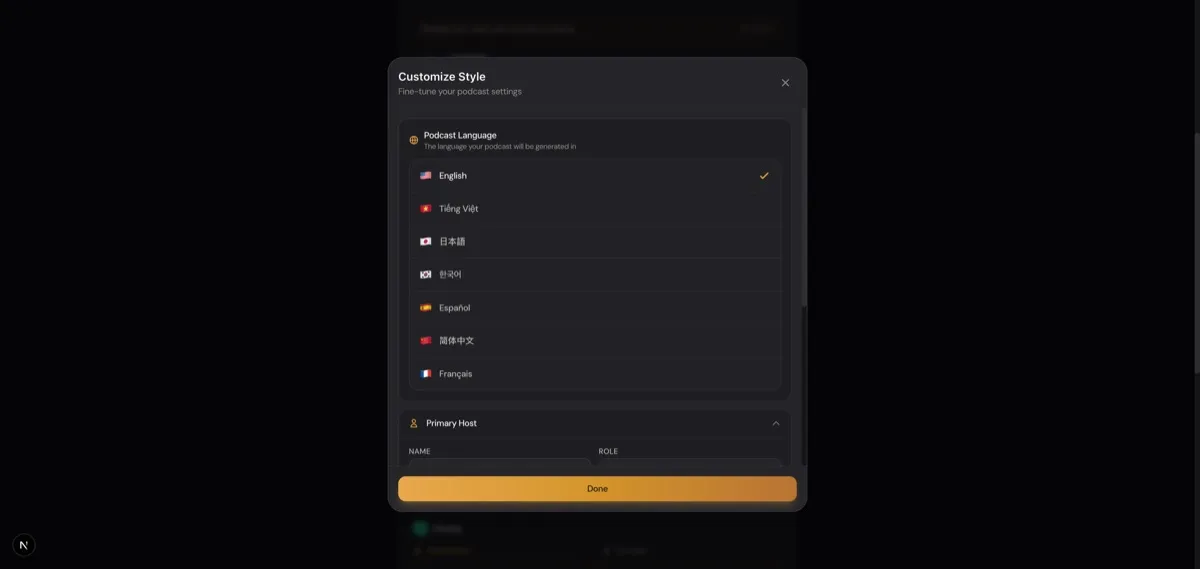
DIALØGUE generates podcasts in seven languages: English, Spanish, French, Japanese, Korean, Vietnamese, and Chinese. The same content, the same structure, delivered natively in each language.
For distributed teams, this means every office gets company updates, training materials, and policy information in their preferred language — without hiring translators or managing separate production workflows.
Templates: Optimized for Business Content
DIALØGUE's eight templates include several designed specifically for professional use:
- Business Analysis — For market commentary, competitive landscape analysis, strategic briefings
- Company Analysis — For company-focused content like organizational updates, financial results, strategic initiatives
- Educational — For training materials, tutorials, onboarding content
- Long-form — For deep training modules, comprehensive policy explanations, technical deep-dives
Each template has pre-configured host personalities and tone settings optimized for its format. You can start with a template and customize from there.
Studio: Scale with Repeatable Show Workflows
Once you've validated a use case (weekly sales briefings, monthly compliance updates, quarterly thought leadership), scale it with Studio.
Studio lets you set up persistent configurations: keywords, template, host personalities, branding, and audience timezone. You then generate episodes on demand without rebuilding the show from scratch.
For thought leadership and regular internal communications, this means consistent output without redoing the setup every time.
Learn more about setting up Studio show workflows.
Getting Started for Teams
If you're considering AI-generated audio for business use, start small:
-
Pick one use case — Don't try to convert everything at once. Start with onboarding materials, or a single training topic, or one recurring communication.
-
Upload an existing document — Use content you already have. A training manual, a whitepaper, a policy document. Upload it as a PDF.
-
Customize the host — Define a host that matches your company's voice. Give them a name, role, and personality that fits your culture.
-
Review the outline before generation — DIALØGUE shows you the outline before creating the full podcast. Make sure the AI understood your content correctly and adjust if needed.
-
Share with your team — Get feedback. Did people actually listen? Did they retain the information? What would make it more useful?
-
Scale what works — Once you've validated the approach, expand to more use cases. Set up Studio shows for recurring content.
Traditional Business Content vs AI Podcast Content
How does AI podcast content compare to the formats businesses already use?
| Factor | Traditional (Whitepapers, Memos, Slide Decks) | AI Podcast Content |
|---|---|---|
| Production time | Days to weeks per piece | Minutes per episode |
| Employee engagement | Low — skimmed or ignored | High — listened during commutes and downtime |
| Accessibility (commute/gym) | Requires screen and attention | Hands-free, eyes-free consumption |
| Update frequency | Quarterly at best | Weekly or daily with Studio automation |
| Cost | $500–$5,000+ per asset (design, review, distribution) | ~$1.11 per episode |
For a detailed cost breakdown, see our AI podcast vs traditional production cost analysis.
Cost Efficiency
Traditional approaches to professional audio content are expensive:
- Hiring a production agency — $3,000–$10,000 per episode for scripting, recording, editing
- In-house production team — Salaries, equipment, studio space, software licenses
- Team member time — Subject matter experts spending hours recording and re-recording
DIALØGUE uses credit-based pricing: $4.99 for 4 episodes, $9.99 for 9 episodes, $19.99 for 18 episodes. No per-seat licensing. No production overhead. Pay for what you create.
For teams creating regular content, this is orders of magnitude more cost-effective than traditional production while maintaining professional quality.
Visit pricing to see detailed team pricing options.
The Real Impact
This isn't about replacing written communication entirely. It's about adding an audio option for the massive segment of your audience that doesn't engage with text-heavy materials.
When employees actually listen to training materials, they're better prepared. When sales reps consume competitive intelligence during their commute, they show up to calls more informed. When customers have audio tutorials as an option, they use your product more successfully.
The technology isn't the point. The engagement is the point.
DIALØGUE removes the production barrier that's kept companies from making professional audio content. The question isn't whether your team should use AI-generated podcasts. It's what you could communicate more effectively if you didn't have to choose between "nobody will read this" and "we can't afford to produce this."
Ready to create business content that your team actually consumes? Start creating your first episode.
Written by
Chandler NguyenAd exec turned AI builder. Full-stack engineer behind DIALØGUE and other production AI platforms. 18 years in tech, 4 books, still learning.
Related Articles


Ready to create your own podcast?
Turn any topic or document into a professional podcast — with outline and script review before audio.
Create a Podcast