AI Podcasts for Korean American Community Organizations
How Korean American community organizations turn service guides and event updates into bilingual audio that reaches families where they are.
I think Korean American community organizations are a very strong use case for DIALØGUE because they often have to do something that is harder than it looks:
communicate clearly, repeatedly, and accessibly without a big media team.
That usually means juggling a mix of:
- program updates
- event announcements
- family resources
- orientation information
- volunteer coordination
- service guides
The content already exists. The need already exists too.
What is usually missing is a format that feels easier to keep up with in real life. That is where I think AI podcasts can help.
Why This Use Case Matters
Community organizations build trust through clear, repeated communication — and audio is one of the most accessible formats for busy families who cannot always sit down with a long document. Community organizations do not just send information. They build trust.
That is why I think the format matters.
If the update is important but the delivery is heavy, people miss it.
If the program is useful but the explanation is buried in a PDF, fewer people act on it.
If the organization is already operating with limited time and staff, creating completely new content from scratch every week is unrealistic.
So I like this use case because it starts from a more honest premise:
the organization already has important material. It just needs a lighter way to deliver some of it.
What Content Fits Audio Best?
Usually, the strongest candidates are the ones that need context and explanation more than visual reference.
| Content type | Why it works in audio |
|---|---|
| Program announcements | Easier to absorb during a busy day |
| Event briefings | Good for reminders and context |
| Resource guides | Useful when explained conversationally |
| Family updates | Strong fit for recurring communication |
| Volunteer coordination notes | Better when summarized clearly |
| Orientation information | Good for step-by-step framing |
Usually weaker fits:
- forms
- highly visual flyers
- detailed schedules people need to scan
- official documents that must be read exactly
So no, I would not try to turn every piece of community communication into a podcast.
I would focus on the updates people are supposed to understand and remember.
Why Audio Instead of Just Sending Another PDF?
The real problem is usually not the document itself — it is that the audience needs explanation and context, not another attachment. Because sometimes the PDF is not the real problem.
The real problem is that the audience is busy, the message needs more context, and the organization does not have time to keep rewriting the same explanation in five different formats.
Audio helps because it can meet people:
- in the car
- while walking
- while cooking
- between jobs, errands, and family responsibilities
The written version still matters. I am not arguing otherwise.
I am just saying some community communication becomes more usable when it sounds like a clear explanation instead of another attachment.
What Would I Launch First?
I would keep it very small at the beginning.
Not "we are launching a content channel."
More like:
- a recurring family update
- a program orientation episode
- a weekly event and resource roundup
- a volunteer briefing before a major event
If one format works, then you can build on it.
If it does not, you stop early. That is a perfectly acceptable outcome too.
What Does the Workflow Look Like?
This is where DIALØGUE is more useful than a plain text-to-speech tool.
1. Start from the real document or source material
Use the materials the organization already has:
- a program guide
- a flyer turned into a PDF
- an orientation document
- a resource summary
- an event brief
If it already exists, use it. Upload it as a PDF.
I prefer that because community-facing communication loses accuracy very quickly when it gets recreated from memory.
2. Review the outline before audio
This is a big one.
Before any final audio is generated, the team can ask:
- are we emphasizing the right things?
- does this sound helpful or just generic?
- is anything missing that people will definitely ask about?
- does the update feel respectful and clear?
That outline review is what makes the workflow feel responsible instead of reckless.
3. Review the script before voice generation
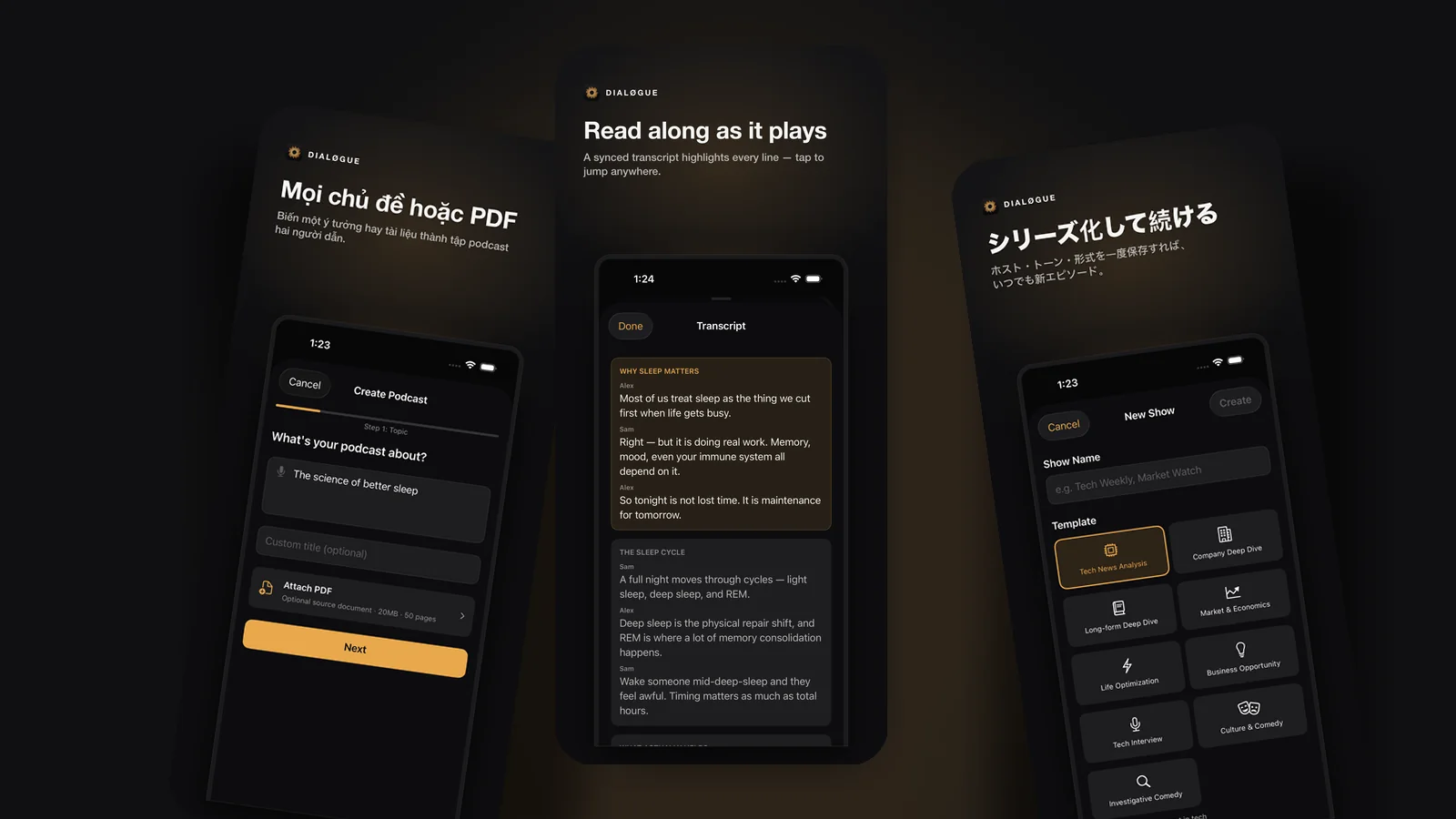
This matters even more when the audience is broad and community-facing. If you have a program guide or event PDF ready, try the full workflow here — both review steps happen before anything becomes final audio.
A script can be technically correct and still be off because:
- the tone sounds robotic
- the message feels too vague
- the emphasis is wrong
- the organization-specific wording gets flattened
That is why I like the second review gate. It gives the team one more chance to make sure the communication still sounds like them.
4. Add bilingual flexibility only where it helps
This is where I think the workflow gets really practical.
Some organizations will benefit from a bilingual path.
Some will not.
I would not automatically create double the workload just because bilingual support exists.
But if the organization genuinely needs both English and Korean communication paths, multilingual podcast creation gives the team more flexibility than a one-language workflow.
Who Is This Best For?
I think this is strongest for:
- Korean American community centers
- nonprofit organizations with family-facing programs
- local groups sharing recurring event and resource updates
- teams that already create documents but want a more human delivery layer
It is especially useful when the organization already has useful information but struggles to make it easy to absorb.
When Would I Not Push This?
I would be careful when:
- the communication is mostly official paperwork
- the audience needs exact visual layouts
- the update is already working perfectly as short text
- the team does not actually have a recurring communication need
Not every organization needs a podcast. Some just need a better email.
Why This Can Actually Be Sustainable
This is the part I care about most.
Community organizations are often asked to do too much with too little.
So any content workflow that only works when a team has extra time is not really a workflow. It is a temporary burst of energy.
This use case can work because it starts with repurposing:
- existing documents
- existing announcements
- existing program information
That is what gives it a chance to be sustainable.
That is also why I think it sits naturally next to AI podcasts for internal communications, AI podcasts for Korean heritage schools in the U.S., and can you create a podcast in multiple languages. For a wider look at the multilingual workflow, the multilingual podcast creation guide covers the full picture.
Where This Fits in the Cluster
I think of this as the community-organization bridge inside the cluster.
If your audience is still mainly a school community, start with AI podcasts for Korean heritage schools in the U.S..
If the real challenge is bilingual delivery, read how to create bilingual English-Korean audio updates.
If you are looking at a more institutional member-briefing model, read AI podcasts for Japanese business associations in the U.S..
My Short Version
Community organizations are already stretched thin. The last thing they need is another content production burden.
That is why I think the only version of this that works is the one built on repurposing. The program guide already exists. The event brief already exists. The family update already exists.
The question is just: would some of those land better as a five-minute audio explanation than as another PDF attachment?
If the answer is yes for even one recurring update, it is worth testing. One document, one workflow, one audience. See if it sticks.
If your organization already has program guides, event PDFs, or family-facing updates, start with one document and see whether the audio version makes the message easier to absorb. For the rest of this cluster, read how to create bilingual English-Korean audio updates, AI podcasts for Korean heritage schools in the U.S., AI podcasts for Japanese business associations in the U.S., and podcast from PDF.
Written by
Chandler NguyenAd exec turned AI builder. Full-stack engineer behind DIALØGUE and other production AI platforms. 18 years in tech, 4 books, still learning.
Related Articles
Ready to create your own podcast?
Turn any topic or document into a professional podcast — with outline and script review before audio.
Create a Podcast