AI Podcasts for Korean Heritage Schools in the U.S.
How Korean heritage schools in the U.S. can turn family updates and orientation PDFs into bilingual audio parents actually absorb.
I think Korean heritage schools in the U.S. are a very practical use case for DIALØGUE, but for a slightly different reason than Japanese supplementary schools.
The communication burden often feels more bilingual and more family-facing.
Not always. Not everywhere. I want to be careful with overgeneralizing here.
But if I were looking for a strong 2026 use case, this is where I would spend time.
These schools often have to communicate clearly about:
- class schedules
- orientation
- events
- volunteering
- curriculum goals
- parent expectations
And they often have to do that in real family life, which means the message is competing with work, commute time, and everything else people are juggling.
That is why I think AI podcasts can help here. Not because schools need more content. Because some of the content they already create would be easier to absorb if it sounded like a clear explanation instead of another document people mean to read later.
Why This Feels Different From the Japanese Use Case
Korean heritage schools in the U.S. tend to lean more toward family communication and bilingual accessibility than the Japanese supplementary school model, which is often more institutional. When I think about Japanese supplementary schools, I think more about institutional communication and structured briefings.
When I think about Korean heritage schools in the U.S., I think more about family communication, community coordination, and bilingual reality.
Again, these are not rigid categories. Real schools are more complicated than neat blog-post buckets.
But I do think the Korean heritage-school angle often leans more naturally toward:
- family updates
- community participation
- bilingual accessibility
- recurring reminders and context
That matters because it shapes what kind of audio workflow is actually useful.
What School Content Fits Audio Best?
Usually, the strongest material is the content that needs explanation, context, or repetition.
| Content type | Why it works in audio |
|---|---|
| Orientation packets | Good for parent-friendly explanation |
| Family updates | Easy to absorb during a busy day |
| Event briefings | Useful when context matters |
| Volunteer coordination notes | Better when summarized clearly |
| Curriculum overviews | Helps families understand the "why" |
| Recurring school announcements | Strong fit for short briefings |
Usually weaker fits:
- registration forms
- complex tables
- classroom worksheets
- anything that depends heavily on visual layout
So I would not turn everything into audio. That is the fastest way to create extra work and call it innovation.
I would start with the things families are supposed to understand and remember.
Why Audio Instead of More Email?
More email is usually not the same thing as better communication — and busy families need explanation, not just delivery. Because more email is usually not the same thing as better communication.
I say that as someone who writes a lot and still knows full well that long written updates lose people.
A school can send a perfectly useful PDF and still have parents miss the point because:
- they read it too quickly
- they open it too late
- they never quite get around to it
- they need explanation, not just information
Audio helps because it meets people in the middle of real life:
- in the car
- between errands
- while cooking
- on a walk
Simple, yet effective. I keep coming back to that.
What Would I Actually Do First?
I would start small.
1. Pick one recurring communication problem
For example:
- monthly family updates
- orientation for new families
- event recap plus next-step reminders
- volunteer briefings
If you try to "launch a podcast strategy" all at once, it will probably get weird very quickly.
If you solve one communication problem well, the workflow has a chance.
2. Use the real source material
If the school already has:
- a newsletter
- an orientation packet
- a family guide
- an event PDF
use that as the starting point. Upload it as a PDF.
That is faster. It is also safer, because family-facing communication is one of those areas where details matter.
3. Review the outline carefully
This is where I think DIALØGUE has a real advantage over generic voice tools.
Before any final audio is generated, the school can review the outline and ask:
- are we emphasizing the right things?
- does this feel helpful to families?
- is anything confusing or overexplained?
- are we missing something parents will definitely ask about?
That review step is where the workflow starts to feel usable, not gimmicky.
4. Review the script before voice generation
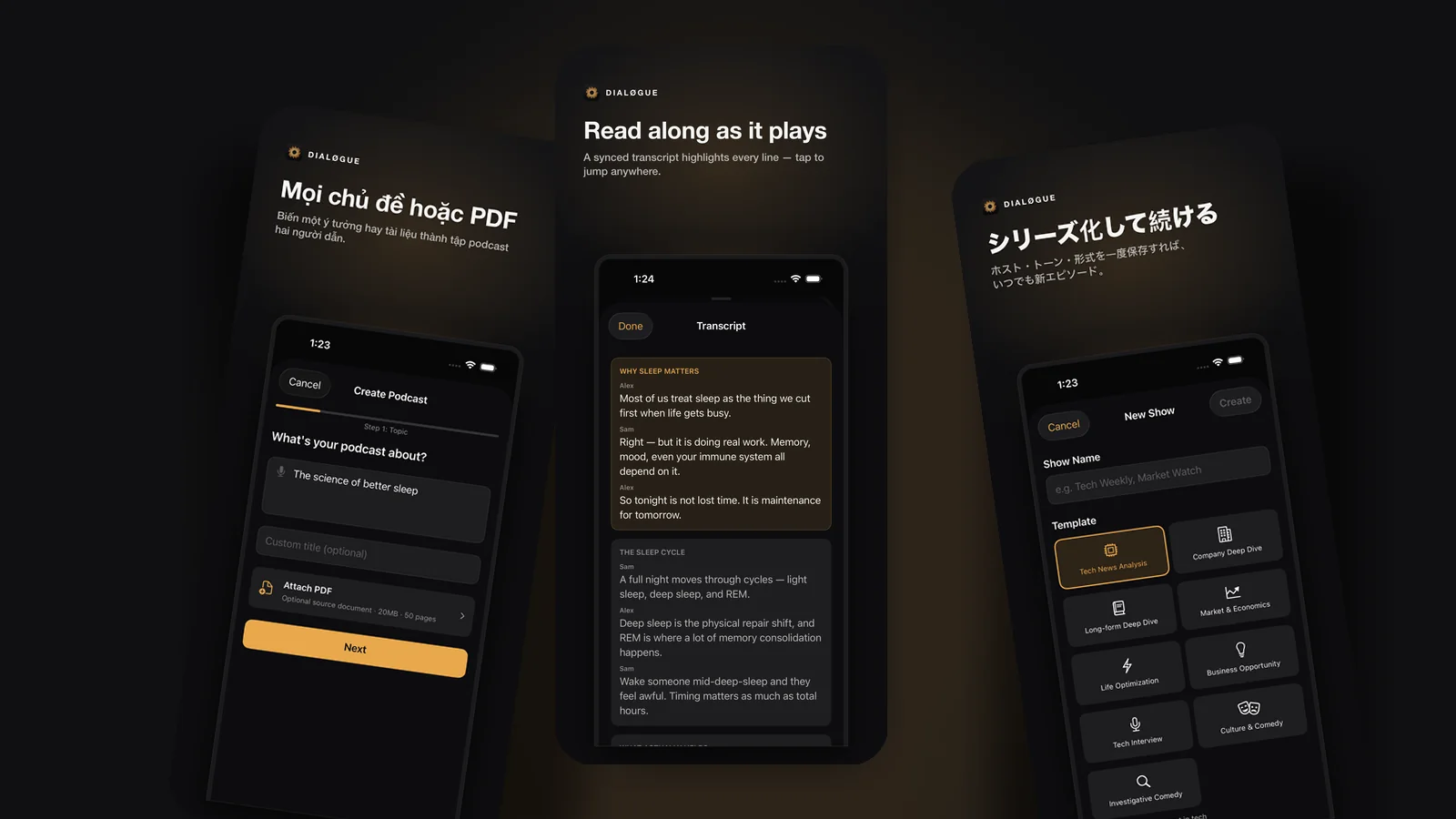
This is the second control point, and I would not skip it. If you have an orientation packet or family guide ready, try the workflow here — both review gates happen before any final audio.
It is where you catch the problems that make communication technically correct but practically off:
- phrasing that sounds robotic
- awkward bilingual transitions
- wrong emphasis
- school-specific wording that needs cleanup
For this kind of use case, review is not bureaucracy. It is quality control.
5. Generate audio only when the message feels right
Then the school can publish:
- a family briefing
- a school update
- an orientation episode
- a recurring bilingual communication layer
Why have another unread PDF when you can have a version families might actually listen to?
Where Bilingual Workflow Matters
This is the part I think matters most for Korean heritage schools in the U.S.
Sometimes the issue is not just "should this be audio?"
It is also:
- should this exist in more than one language?
- how much translation is actually useful?
- how do we make the communication more accessible without doubling the workload?
I do not think every school should suddenly publish everything in English and Korean. That sounds exhausting.
But I do think some schools would benefit from a workflow that can support bilingual communication without rebuilding the process every time.
That is why multilingual podcast creation matters here. Not as a flashy feature. As operational flexibility.
Where This Fits in the Cluster
I think of this as the Korean school-side anchor for the cluster. For the broader view of how AI podcasts work in education, that post covers the wider landscape.
If you want the workflow version, read how to create bilingual English-Korean audio updates.
If you want the Japanese school counterpart, read AI podcasts for Japanese supplementary schools in the U.S..
If your use case is broader than a school, read AI podcasts for Korean American community organizations.
Who Is This Best For?
I think this is strongest for:
- Korean heritage schools already sending regular family updates
- school teams balancing Korean and English communication needs
- community-based programs that rely on volunteer coordination
- schools that want a more human way to explain expectations and events
It is especially useful when the written communication already exists, but the school wants a better way to help families keep up.
When Would I Not Push This?
I would be careful when the communication depends mainly on:
- forms that must be completed exactly
- calendars people need to scan visually
- highly visual teaching materials
- content where a short text message already does the job perfectly
Not everything needs a podcast. That is true for schools, companies, and pretty much everything else.
My Short Version
The schools that get the most out of this are the ones that already have a communication rhythm and just want it to land better.
Not a podcast strategy. Not a content channel. Just a way to take the orientation packet that took two weeks to write and turn it into something a parent can listen to on the way to pickup.
That is the whole pitch. If it works, do it again next month. If it does not, you stop early and the only cost was one test.
If your school is already sending family updates, orientation guides, or event PDFs, start with one document and see if the audio version is easier to absorb. For the rest of this cluster, read how to create bilingual English-Korean audio updates, AI podcasts for Japanese supplementary schools in the U.S., AI podcasts for Korean American community organizations, and podcast from PDF.
Written by
Chandler NguyenAd exec turned AI builder. Full-stack engineer behind DIALØGUE and other production AI platforms. 18 years in tech, 4 books, still learning.
Related Articles

Ready to create your own podcast?
Turn any topic or document into a professional podcast — with outline and script review before audio.
Create a Podcast