How to Build a Branded Podcast That Actually Sounds Like You
Build a podcast that matches your brand identity with custom hosts, tone controls, and specialized templates. A practical guide to creating distinctive audio content.
A branded podcast strategy uses AI-generated audio content to build brand authority, deepen customer relationships, and scale thought leadership — without the production overhead of traditional podcasting. Branded podcasts are having a moment. Companies from Shopify to Slack are using audio content to build thought leadership, engage audiences, and create marketing assets that actually get consumed. But here's the problem with most AI podcast tools: they produce the same generic, cookie-cutter content regardless of who's using them.
The difference between a forgettable AI podcast and one that becomes a genuine extension of your brand comes down to customization depth. Can you control the host's personality? Can you match your brand's communication style? Can you choose templates that align with your content strategy?
This guide will show you how to build branded podcasts that do not sound like every other AI-generated show — because customization and review make all the difference.
Why Do Branded Podcasts Matter in 2026?
Audio content is uniquely powerful for B2B and B2C brands alike. A podcast episode can demonstrate thought leadership, explain complex products, or provide value to your audience in a format they can consume while commuting, exercising, or working.
More importantly, a single podcast episode becomes a content multiplier: transcripts for blog posts, quotes for social media, clips for video content. But only if the original audio sounds authentically like your brand.
How Do You Match Your Brand Voice in a Podcast?
Your brand already has a communication style — whether it's in your marketing copy, customer emails, or social media presence. The key to a successful branded podcast is translating that identity into podcast settings and then reviewing the output before it becomes final audio.
Host Personalities Define Your Show
The host is the voice of your podcast, and that voice should reflect your team's expertise and personality. Instead of accepting a generic "friendly narrator," you can define exactly who your hosts are.
For more details on creating authentic hosts, see our guide on AI Voice Customization.
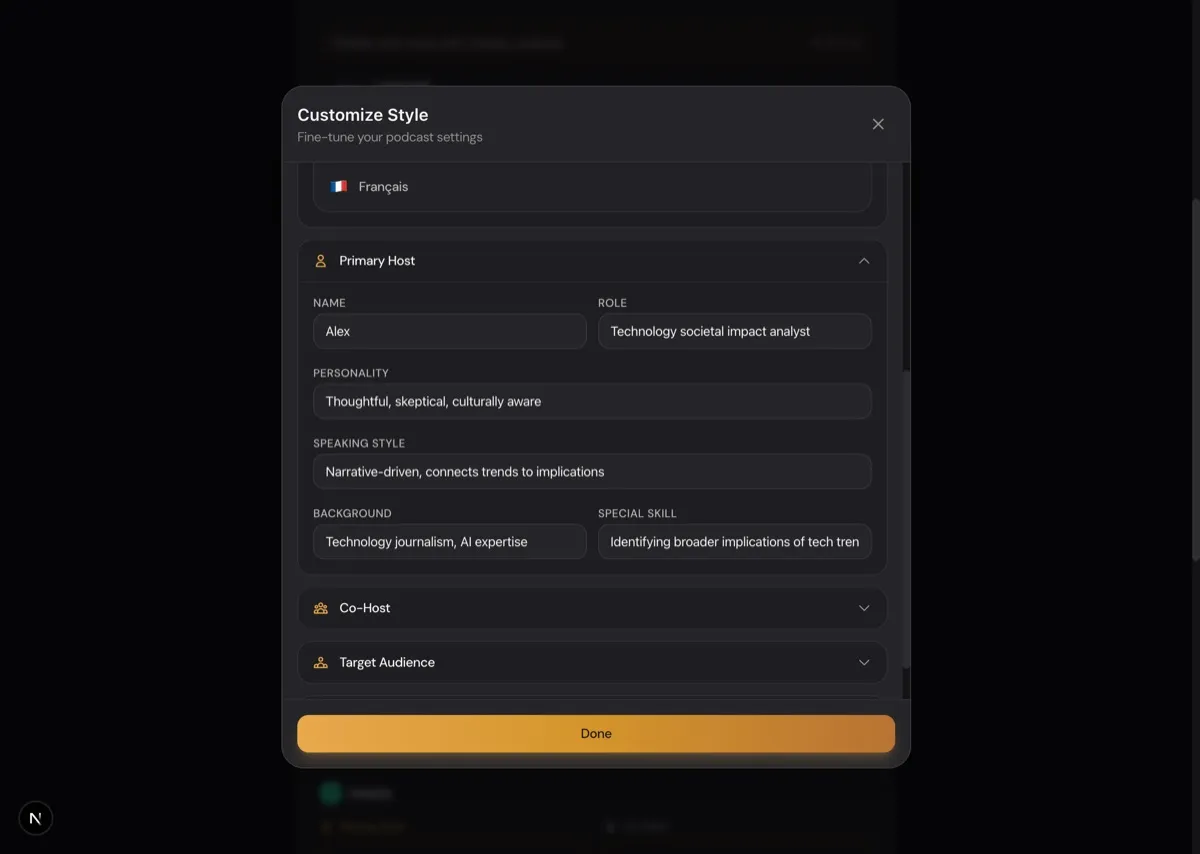
Think about your brand:
- A fintech company might want "a financial analyst with 15 years of Wall Street experience who explains complex markets clearly"
- A fashion brand might choose "a trend forecaster who's enthusiastic about sustainable design and emerging designers"
- A SaaS company could use "a product manager who's technical but talks to non-technical audiences daily"
The more specific you are about host personalities, the more the final podcast reflects your brand's expertise and perspective.
Tone Sliders Match Your Communication Style
Beyond the host's background, tone controls let you fine-tune how formal, humorous, or energetic the conversation should be.
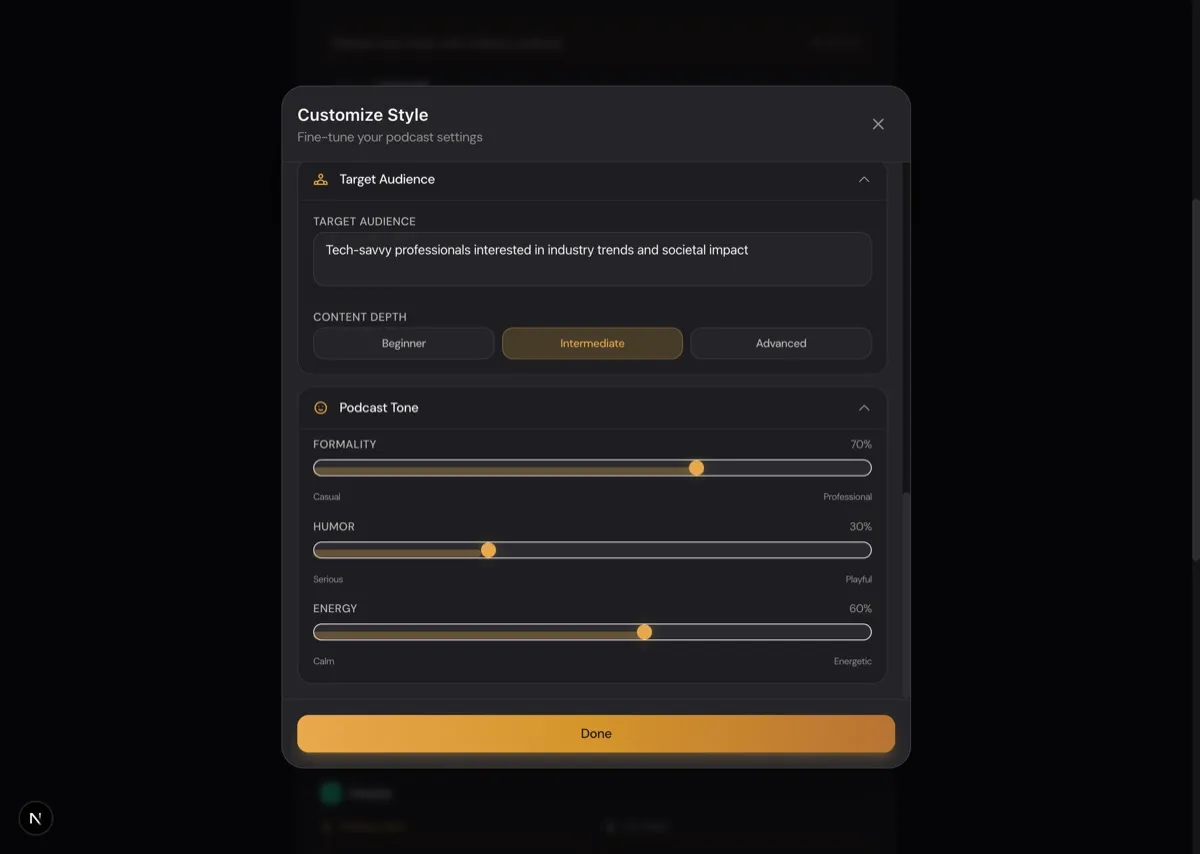
Consider these examples:
A buttoned-up B2B enterprise software company:
- Formality: 90%
- Humor: 10%
- Energy: 40%
- Result: Professional, serious, authoritative — like a keynote presentation
A playful consumer brand targeting Gen Z:
- Formality: 20%
- Humor: 70%
- Energy: 80%
- Result: Conversational, entertaining, relatable — like chatting with a friend
A healthcare organization:
- Formality: 70%
- Humor: 20%
- Empathy: 90%
- Result: Trustworthy, approachable, compassionate — like a good doctor
These are not superficial changes. They alter how the AI approaches the script, the language it uses, and the dynamic between hosts. A high-formality podcast will use precise terminology and structured arguments. A high-energy podcast will have more back-and-forth exchanges and varied pacing.
Build your brand's voice today. Create a branded podcast episode and customize every aspect of your hosts' personality.
Brand Tone Examples
| Brand Tone | Formality | Humor | Energy | Example Use Case |
|---|---|---|---|---|
| Corporate / Professional | 85–95% | 5–15% | 30–50% | Enterprise software, financial services, consulting firms |
| Startup / Casual | 20–40% | 50–70% | 70–85% | Consumer apps, DTC brands, community-driven products |
| Educational / Authoritative | 60–80% | 15–30% | 40–60% | Online courses, research institutions, healthcare providers |
| Entertainment / Energetic | 10–30% | 60–80% | 80–95% | Gaming, lifestyle brands, pop-culture media |
Choosing the Right Template
Template selection is about content strategy. Different formats serve different marketing goals. For B2B use cases, also check out our guide on podcasts for business.
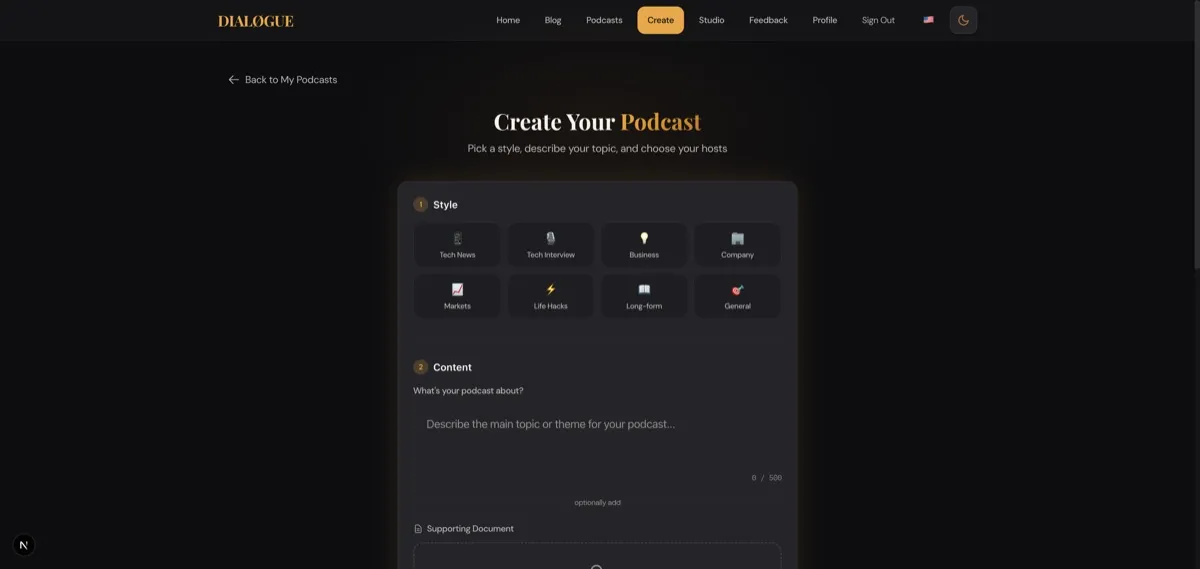
Tech News → Weekly Industry Updates
If your brand needs to demonstrate thought leadership on current events, the Tech News template structures content around recent developments. Perfect for:
- Software companies commenting on industry trends
- Consulting firms discussing market changes
- Media brands covering emerging technologies
Business Analysis → Market Commentary
The Business Analysis template dives deep into companies, industries, and business models. Use this for:
- Investment firms explaining market opportunities
- B2B brands educating prospects on industry challenges
- Strategic consultancies showcasing analytical thinking
Interview → Guest-Style Features
The Interview template simulates a conversation between a host and an expert. Ideal for:
- Highlighting customer success stories
- Featuring internal subject matter experts
- Discussing partnerships or collaborations
Long-form → Deep Research Pieces
When you need comprehensive, authoritative content on complex topics, the Long-form template provides the structure for in-depth exploration. Great for:
- Technical products requiring detailed explanation
- Whitepapers or reports you want to repurpose as audio
- Educational content for professional development
Each template comes with different pacing, segment structures, and research approaches. Match the template to your content marketing goals, not just the topic at hand.
Audience Targeting: Who Are You Speaking To?
Defining your audience changes everything about the script. The same topic — say, "cloud security" — will be explained completely differently for beginners versus advanced practitioners.
Beginner-level content for awareness stage:
- More definitions and context
- Analogies and relatable examples
- Slower pacing with clear signposting
- Use case: Top-of-funnel content marketing
Advanced-level content for industry insiders:
- Assumes baseline knowledge
- Dives into technical nuances
- Faster pacing with denser information
- Use case: Thought leadership for peers and prospects already in your space
This is particularly important for B2B brands. You don't want a podcast aimed at C-suite executives to sound like a tutorial for interns, and vice versa.
Multilingual Brand Reach
If your brand operates globally, multilingual podcasts unlock content localization without the traditional overhead of translation, re-recording, and editing.
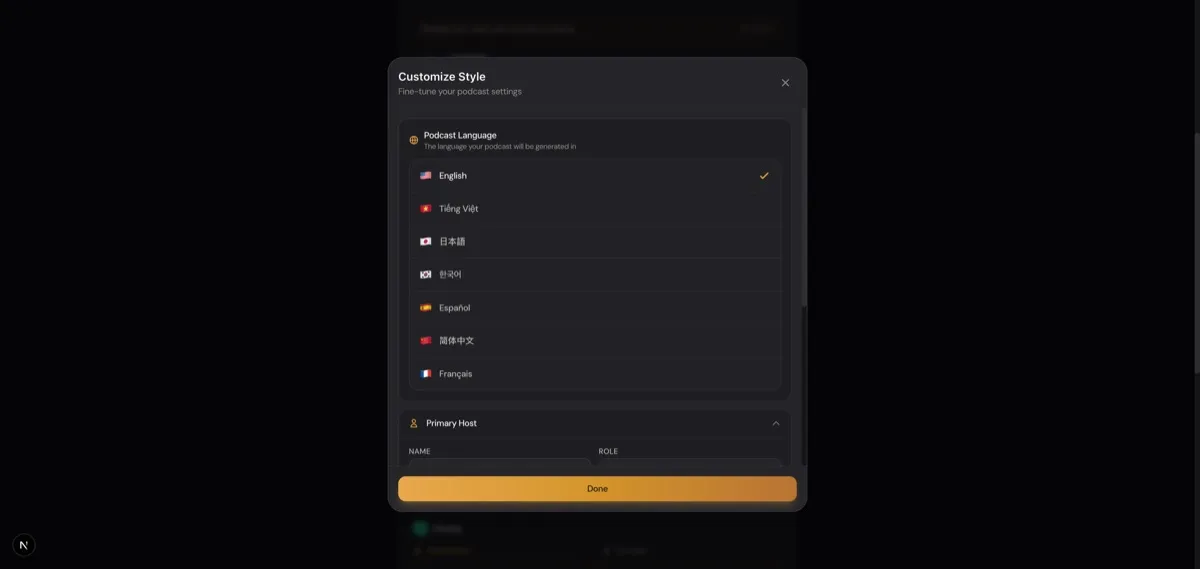
Seven languages are supported: English, Vietnamese, Japanese, Korean, Spanish, Chinese, and French. This means a single content strategy can reach audiences in their native languages.
For example, a global SaaS company could:
- Create an English podcast on product updates for North American customers
- Generate the same content in Japanese for the APAC team
- Localize to Spanish for Latin American markets
The AI doesn't just translate — it adapts tone and cultural references for each language. This is content localization, not mechanical translation. That is also why review matters so much; multilingual brand output should be checked as a publishing workflow, not trusted blindly.
Scaling with Studio: Consistent Branded Content
The challenge with branded podcasts isn't creating one episode — it's maintaining consistency over time. That's where Studio comes in.
Studio lets you set up a repeatable show workflow with persistent branding:
- Define your show's keywords and focus areas
- Set your hosts, tone, and template once
- Schedule episodes daily, weekly, or on-demand
- Reuse the same show setup whenever you have a new topic to cover
For brands, this means you can run a weekly podcast series without constantly reconfiguring settings or briefing new freelancers. Your brand voice stays consistent, and your content calendar stays full.
Learn more about setting up Studio show workflows for your brand.
Getting Started: From Brand Identity to Audio
Here's a practical workflow:
-
Audit your existing brand voice. How do you currently communicate? What tone do your marketing materials use? Who writes your best content?
-
Define your podcast goals. Thought leadership? Product education? Industry commentary? This determines your template choice.
-
Describe your ideal host. What's their background? What's their relationship to your audience? Are they explaining, interviewing, or analyzing?
-
Set your tone sliders. Match them to your brand guidelines. Test a sample episode and adjust.
-
Choose your audience level. Are you speaking to beginners, intermediates, or experts in your field?
-
Create a test episode. Listen critically. Does it sound like your brand? Adjust and iterate.
-
Set up a Studio show for recurring content if you're committing to a series.
The difference between a generic AI podcast and a genuine brand asset is intentionality. With the right settings, your podcast becomes an authentic extension of your brand voice.
For a cost breakdown of AI-generated vs. traditionally produced branded podcasts, see our AI podcast vs traditional cost comparison. To learn how branded podcasts fit into a broader marketing funnel, check out AI podcasts for marketing.
Ready to build your branded podcast? Start creating with DIALØGUE and see how deep customization makes all the difference.
Written by
Chandler NguyenAd exec turned AI builder. Full-stack engineer behind DIALØGUE and other production AI platforms. 18 years in tech, 4 books, still learning.
Ready to create your own podcast?
Turn any topic or document into a professional podcast — with outline and script review before audio.
Create a Podcast