How to Turn Japanese School Newsletters into a Podcast
Step-by-step workflow for turning Japanese school newsletters into podcast episodes families actually listen to. PDF upload, outline review, and script approval.
I think this is one of the cleanest workflows in the whole cluster because the starting asset already exists.
The school has a newsletter.
Parents are supposed to read it.
Some do. Some skim. Some mean to come back to it later and do not.
That is not a criticism. That is just real life.
Yes, you can turn a Japanese school newsletter into a podcast, and I think it works best when the goal is not "make everything audio." The goal is "make the important parts easier to absorb."
Why Newsletters Are a Good Starting Point
Newsletters are the best starting asset for school podcasts because they already contain structured, recurring updates — no blank-page content creation needed. School newsletters already contain most of what the audio version needs:
- updates
- reminders
- event context
- school notices
- recurring parent communication
That means you are not inventing new content. You are repackaging content the school already worked to produce.
I like that because blank-page workflows usually sound exciting in theory and exhausting in practice.
What Parts of the Newsletter Should Stay the Same?
The core message should stay the same.
What changed this month?
What do parents need to know?
What should families remember?
That part should survive.
What should not survive unchanged is the page format.
A newsletter can work well on paper or in email and still sound terrible when read aloud.
What Should Change for Audio?
The core message stays; the page format does not. This is where the adaptation work matters.
Usually, I would keep:
- the main updates
- the important reminders
- the event explanations
- the practical next steps
Usually, I would compress or cut:
- tables
- repeated formatting language
- layout-dependent sections
- forms and sign-up details that need to be scanned visually
The audio version should sound like a useful parent briefing, not a robot reading a school PDF.
What Is the Best Workflow?
This is the workflow I would actually use.
1. Start with the real newsletter
Do not summarize it from memory if you do not have to.
Use the actual file. Upload it as a PDF.
That matters because school communication can get vague very quickly when people try to "recreate the essence" instead of working from the actual source.
2. Decide what families should walk away with
Before you generate anything, ask:
- what are the two or three most important updates?
- what do families actually need to understand?
- what can stay in writing only?
This step is simple, yet effective.
It also prevents the episode from turning into an audio dump of every newsletter section.
3. Review the outline before audio
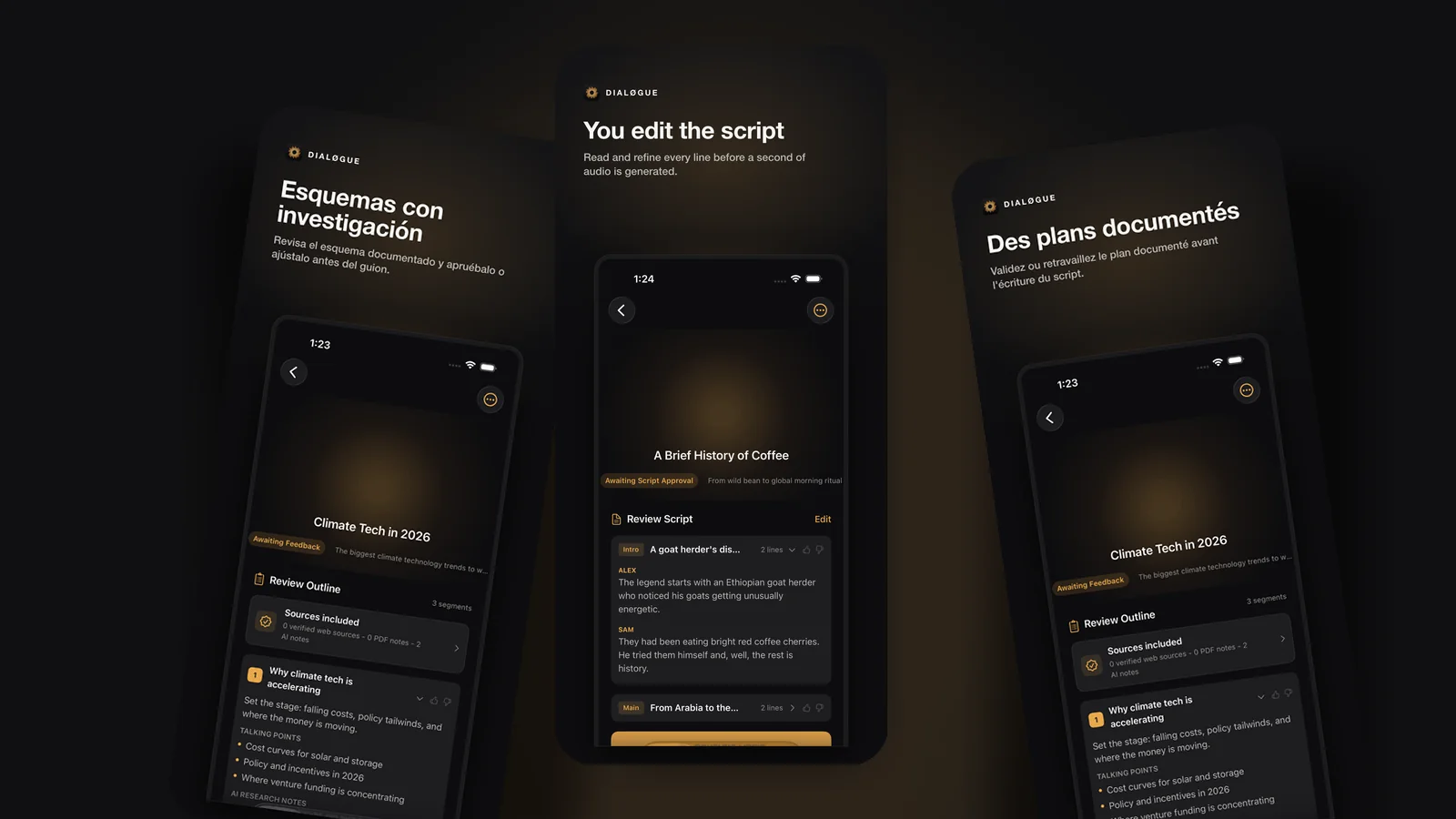
This is where I think DIALØGUE becomes more useful than a plain voice tool.
The outline review lets the school ask:
- are we emphasizing the right things?
- did the AI keep too much low-value detail?
- is anything sensitive or confusing being framed poorly?
- does this sound helpful to parents?
For school communication, this review step is not optional fluff. It is the first safety rail.
4. Review the script before voice generation
This is the second safety rail. If you have a newsletter ready to test, try the full workflow here — you will see both review gates before any audio is generated.
It is where you catch the problems that make something technically correct but practically off:
- awkward wording
- bad transitions
- poor emphasis
- school-specific phrases flattened into generic language
That is why I like the two-step review model:
- outline review
- script review
It gives the school control before anything becomes final audio.
5. Keep the written version for reference
This part matters.
I would not replace the newsletter with the podcast.
I would use the podcast as the explanation layer and keep the written version for:
- forms
- schedules
- sign-up details
- anything people need to reference later
Less is more here. Audio for understanding. Written material for precision.
What Makes a Newsletter a Strong Fit?
I think the strongest newsletters have:
| Signal | Why it helps |
|---|---|
| Clear monthly updates | Gives the episode structure |
| Parent-facing explanations | Good spoken material |
| Recurring format | Easier to repeat over time |
| Event reminders | Useful in audio |
| Reasonable length | Less cleanup required |
Usually weaker fits:
- image-heavy newsletters
- calendar-heavy documents
- highly administrative notices
If the newsletter mostly explains and reminds, it is a strong candidate.
Where This Fits in the Cluster
I think of this as the tactical follow-on to AI podcasts for Japanese supplementary schools in the U.S.. For the broader picture of how AI podcasts work in education, that post covers the wider use case.
If you are comparing Japanese and Korean school communication, read AI podcasts for Korean heritage schools in the U.S..
If the newsletter challenge is really a bilingual delivery problem, pair this with how to create bilingual English-Korean audio updates.
Who Is This Workflow Best For?
I think this is strongest for:
- Japanese supplementary schools already sending regular newsletters
- school coordinators who keep repeating the same explanations
- programs with strong written habits but weak content consumption
- teams that want a more human communication layer without building a studio
It is especially useful when the school already has a rhythm and just wants a better delivery format.
When Should You Not Turn the Newsletter into a Podcast?
I would not push this if the newsletter is mostly:
- forms
- schedules
- tables
- visual notices that need scanning
In those cases, a short audio summary may still help, but the whole document should not become the episode.
My Practical Take
I like this workflow because it does not ask the school to become a media company.
The newsletter is already done. The audience is already there. The cadence is already set.
All this adds is a lighter delivery layer on top of something that already works — just not as well as it could.
If even one parent listens to the audio version who would not have read the PDF, the workflow has already paid for itself.
If your school already has a newsletter sitting in PDF form, start with that document and see if the audio version is easier for families to keep up with. For the rest of this cluster, read AI podcasts for Japanese supplementary schools in the U.S., AI podcasts for Korean heritage schools in the U.S., how to create bilingual English-Korean audio updates, and podcast from PDF.
Written by
Chandler NguyenAd exec turned AI builder. Full-stack engineer behind DIALØGUE and other production AI platforms. 18 years in tech, 4 books, still learning.
Related Articles
Ready to create your own podcast?
Turn any topic or document into a professional podcast — with outline and script review before audio.
Create a Podcast