AI Podcasting in 2026: 4 Formats That Work (And 1 to Avoid)
Recurring business updates, document explainers, localization, and recaps: where AI podcasting works in 2026. Plus the one format that still falls flat.
AI podcasting is no longer in the “can this exist?” stage. The more useful question in 2026 is whether the format you want is actually a good fit for synthetic audio. That is where most of the confusion lives.
Some people are still debating whether AI audio is “real podcasting.” That is not the practical decision most teams need to make. The practical decision is simpler:
- where does AI audio save real time and production overhead?
- where does it still produce something listeners tolerate once but do not come back to?
We pressure-tested this argument in a real generated episode before writing the post. The point of the exercise was not to produce another abstract take on AI. It was to test whether a real episode on a commercially relevant topic could hold up as actual listening material.
The answer is yes, but only in the right formats.
The Wrong Question Is “Can AI Do This?”
AI can generate a lot of things that are technically acceptable. That does not mean the format is a strong fit.
The better question is:
What is the listener actually here for?
If the listener wants:
- clarity
- speed
- consistency
- structured explanation
AI podcasting is often strong.
If the listener wants:
- a specific host's personality
- real chemistry
- emotional unpredictability
- the feeling of listening in on a real encounter
AI still struggles.
That distinction matters more than almost any model benchmark or voice demo.
Four Formats Where AI Podcasting Actually Works
These are the categories where AI audio earns its keep right now.
| Format | Why It Works | What To Watch |
|---|---|---|
| Recurring business updates | Repeatable structure, short shelf life, consistency is a benefit | Bad inputs can sound more authoritative than they should |
| Document explainers | Existing source material already gives the episode structure | AI can flatten nuance or over-smooth strong arguments |
| Multilingual localization | You can adapt proven content into new markets faster | Literal translation and weak editorial review still break trust |
| Trend roundups and recaps | Speed matters and the format is already templated | Context and differentiation still need human judgment |
The common thread is that these formats are information-first. The value lives in getting something useful, understandable, and publishable without forcing a human production workflow onto content that does not need it.
1. Recurring Business Updates
This is probably the cleanest fit.
Weekly internal briefings, client updates, earnings summaries, status reports, and leadership recaps already have a predictable structure. They also expire quickly. That matters because it changes the economics.
If something is only valuable for a few days, it rarely makes sense to attach a full traditional production workflow to it. AI audio works well here because:
- consistency is a feature, not a bug
- the audience wants the signal, not the host
- a stable format builds listener habit over time
That does not mean “publish without thinking.” It means the human review moves up a level. Instead of reviewing every line like a handmade show, the human owns the template, the logic, and the safety checks.
2. Document Explainers Built From Existing Source Material
This is where AI podcasting starts to feel genuinely useful rather than merely efficient.
Whitepapers, research reports, policy memos, onboarding guides, and PDFs already contain the hard part: structure. AI is good at turning that structure into a conversational path that a listener can follow.
The biggest advantage is orientation. A good document-to-audio workflow helps someone understand the shape of a report before deciding what deserves deeper reading.
The biggest limitation is that AI explainers often drift toward the safest possible interpretation. They can preserve the facts while sanding down the edge of the argument. That is why turning a PDF into a podcast works best when a human still checks:
- whether the real claim survived
- whether the controversial or important parts got flattened
- whether the target audience is the one the script is actually speaking to
3. Multilingual Publishing and Localization
AI has made this far more practical, but a lot of teams still talk about it in inflated terms.
The real win is not “we launched in twelve languages overnight.” The real win is being able to take a proven English-language episode family and create localized versions for specific markets without rebuilding the workflow from scratch every time.
That is valuable when:
- you already have evidence that the source topic works
- you know which audience or market you want to reach next
- you are willing to review for tone, idiom, and cultural fit
The weak version is translation theater. The strong version is localization with editorial intent. If you want the broader workflow view, the closest companion piece is Can You Create a Podcast in Multiple Languages?.
4. Trend Roundups and Recaps
This is one of the most obvious AI wins because the format was already partly templated before AI got involved.
Daily briefings, weekly industry digests, market recaps, regulatory summaries, and category roundups all share the same basic strengths:
- the value decays quickly
- speed is part of the product
- the audience mainly wants a clear synthesis
Where teams get into trouble is assuming that fast and useful automatically becomes memorable. It usually does not.
AI recaps are strongest when they are positioned as efficient, reliable briefings. They get much weaker when people try to pretend they are personality-led shows. That is also where the best AI voices for podcasts becomes relevant: the voice pairing should support clarity and pacing, not perform fake intimacy.
The One Format We'd Still Avoid
If the whole point of the show is chemistry, AI still falls flat.
That means personality-driven interview podcasts remain the weakest fit.
The reason is not just “the voices sound fake.” In fact, that is often not the main problem anymore. The deeper problem is that the structure of a real interview depends on things AI still does badly:
- genuine surprise
- tension
- awkward pauses that mean something
- specific host instincts
- a feeling that two real people are meeting in real time
When those qualities are missing, the conversation often sounds smooth but hollow. Listeners may not describe it that way, but they feel it. The average follow-up question is not the memorable one. The polished version of a human stumble is often less interesting than the stumble itself.
This is the simplest rule in the whole article:
If the hosts are interchangeable, AI may be a good fit. If the value depends on these specific people talking, keep the human voice at the center.
What This Means for Voice Selection
This post is really a format argument, but it still matters for voice choice.
The reason some AI voice pairings work is not only that the voices are technically good. It is that the format gives them a job they can succeed at.
For structured explainers, briefings, and recaps, a strong pairing usually looks like:
- one steady anchor voice
- one slightly warmer or more reactive co-host
That pairing supports:
- clear transitions
- natural emphasis
- enough contrast to avoid monotony
What it cannot do is manufacture real interpersonal history. That is why voice quality and format fit have to be judged together, not separately.
A Simple Decision Framework
Before you make a new AI podcast series, ask four questions:
- Is the listener here for information or for emotional connection?
- Does this content expire in days, or should it hold up for months?
- Does consistency matter more than personality?
- Can a human keep the editorial layer while AI handles the repeatable production work?
If the answers point toward structure, speed, and repeatability, AI is probably a strong fit.
If the answers point toward personality, vulnerability, and a specific host relationship, keep humans at the center and use AI around the workflow instead of inside the performance.
Where I'd Start
I would not start with a flagship interview show.
I would start with one pilot in a format that is already structured:
- a weekly client briefing
- a PDF explainer
- a localized version of a proven episode
- a recap feed
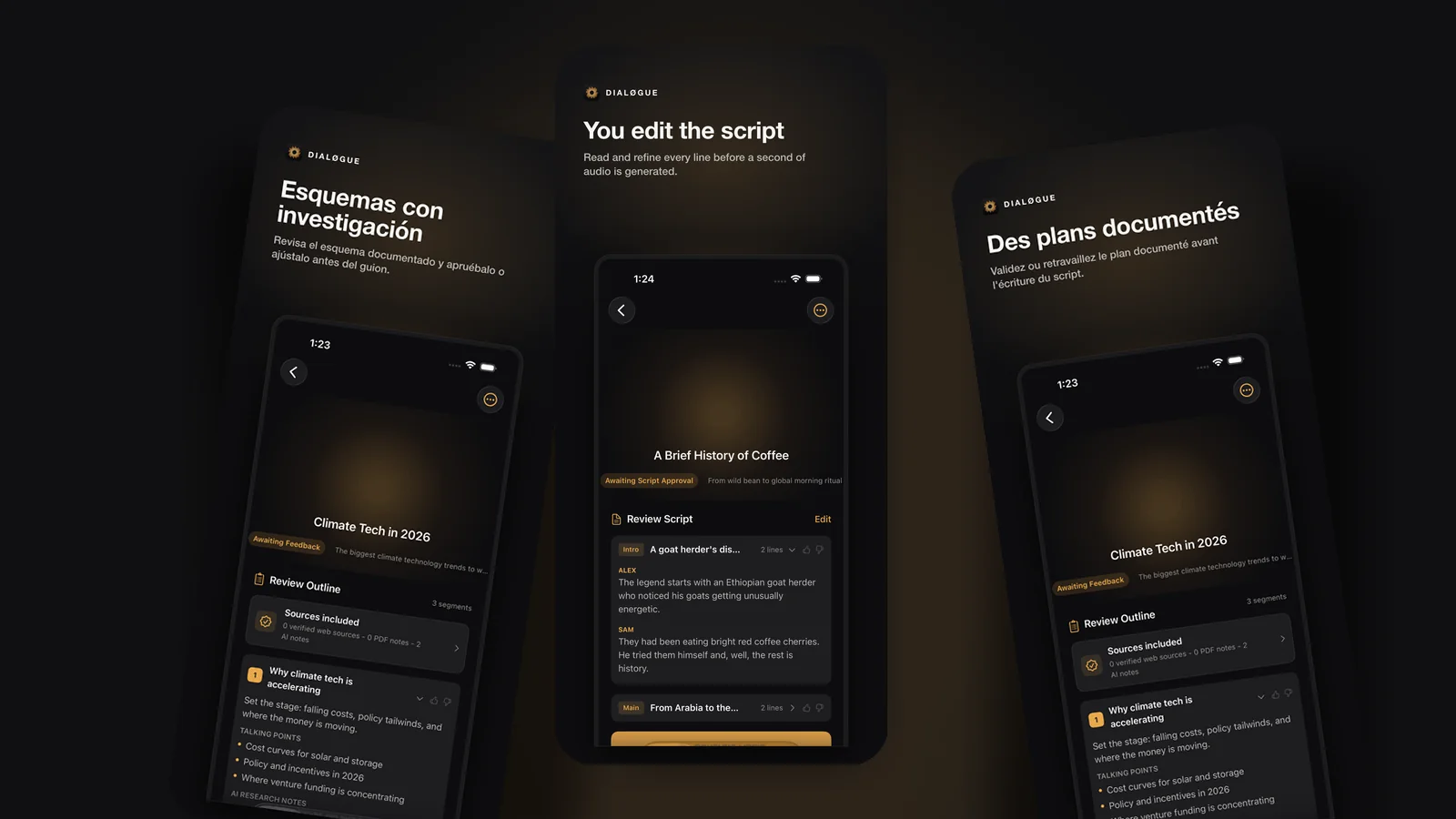
Run that pilot through the full workflow. Review the outline. Review the script. Then generate the audio and judge the result honestly.
That will tell you more than another abstract debate about AI ever will.
If you want to test this with a real topic, create a podcast and start with something information-heavy and repeatable. For adjacent reads, go to 279 Best AI Voices for Podcasts in 2026, Podcast From PDF, Can You Create a Podcast in Multiple Languages?, and the full AI podcast generation guide.
Written by
Chandler NguyenAd exec turned AI builder. Full-stack engineer behind DIALØGUE and other production AI platforms. 18 years in tech, 4 books, still learning.
Related Articles


Ready to create your own podcast?
Turn any topic or document into a professional podcast — with outline and script review before audio.
Create a Podcast