How to Turn a Whitepaper into a Podcast Without Losing the Good Parts
A practical guide to turning whitepapers into podcast episodes with AI. Learn what to keep, what to simplify, and how to make dense written material work in audio.
I have a soft spot for whitepapers because they usually contain the good stuff people worked hard to figure out. I also know most whitepapers are too dense to travel very far in the real world.
People download them. A smaller number skim them. An even smaller number finish them.
Yes, you can turn a whitepaper into a podcast, and in many cases it works surprisingly well. But the trick is not to read the document out loud. The trick is to preserve the argument, the useful evidence, and the takeaway while cutting the parts that only make sense on a page.
That is the workflow I care about here.
Why Are Whitepapers Good Source Material for Podcasts?
A strong whitepaper already has three things an audio episode needs:
- a clear topic
- a structured argument
- evidence or examples
That means you are not starting from nothing. You are starting from a piece of thinking that already has shape.
This is one reason document-based podcasting is so useful for teams with existing content libraries. The challenge is usually not "what should we say?" The challenge is "how do we make anyone actually consume this?"
For the broader document workflow, see how to convert a PDF to a podcast.
What Makes a Whitepaper Good for Audio?
Not every whitepaper adapts equally well.
The best ones usually have:
| Strong signal | Why it helps in audio |
|---|---|
| Clear thesis | Gives the episode a spine |
| Distinct sections | Makes the conversation easier to structure |
| Useful examples | Easier to explain verbally |
| Actionable takeaway | Gives the listener a reason to care |
| Reasonable density | Less cleanup before adaptation |
Usually weaker fits:
- slide-export PDFs pretending to be whitepapers
- documents that rely heavily on charts
- ultra-technical material that depends on formulas or tables
- papers with lots of repetition and little narrative
If the written document already teaches, argues, or explains clearly, you are in a good place.
What Should Stay the Same?
The thesis should stay the same. The format should not.
I think this is where people get sloppy. They treat the document as raw text and forget that the point of the whitepaper is its reasoning structure.
What I try to preserve:
- the main argument
- the most useful supporting points
- the tension or problem being solved
- the practical takeaway
If those survive, the episode usually still feels faithful to the source.
What Should Change for Audio?
This is where the real adaptation work happens.
Cut or compress the screen-dependent parts
These usually need to be summarized:
- charts
- tables
- footnotes
- long citations
- visual comparisons
Add spoken logic
Listeners need more verbal signposting than readers do.
Helpful phrases:
- "Here is the problem the report is trying to solve"
- "The important takeaway is not the number itself, but what it implies"
- "There are two reasons this matters"
Make the explanation feel human
This is where the conversational format helps. A good podcast version of a whitepaper feels less like a lecture and more like a smart discussion of what the document actually means.
What Is My Practical Workflow?
Here is the process I would use.
1. Start with the source document
Use the whitepaper itself as the source material. Do not rebuild it from memory if you do not have to.
This matters because whitepapers often contain:
- careful wording
- precise claims
- good examples
- structured argument flow
If you already have a PDF, use it.
2. Decide what the listener should walk away with
This is the most important editorial step.
Ask:
- What is the one idea worth remembering?
- What is the practical implication?
- Who should care about this?
If the answer is vague, the episode will probably be vague too.
3. Trim the dead weight
Whitepapers often include sections that are useful in print but painful in audio:
- methodology detail beyond what listeners need
- every data point in a table
- repeated positioning language
- long executive-summary repetition
I would rather lose some detail than keep the episode stiff.
4. Choose the right format
Most whitepapers adapt best into one of these:
- Educational
- Business Analysis
- Company Analysis
That depends on whether the document is mainly:
- teaching
- evaluating
- recommending
If you need a refresher on format fit, see the podcast templates guide.
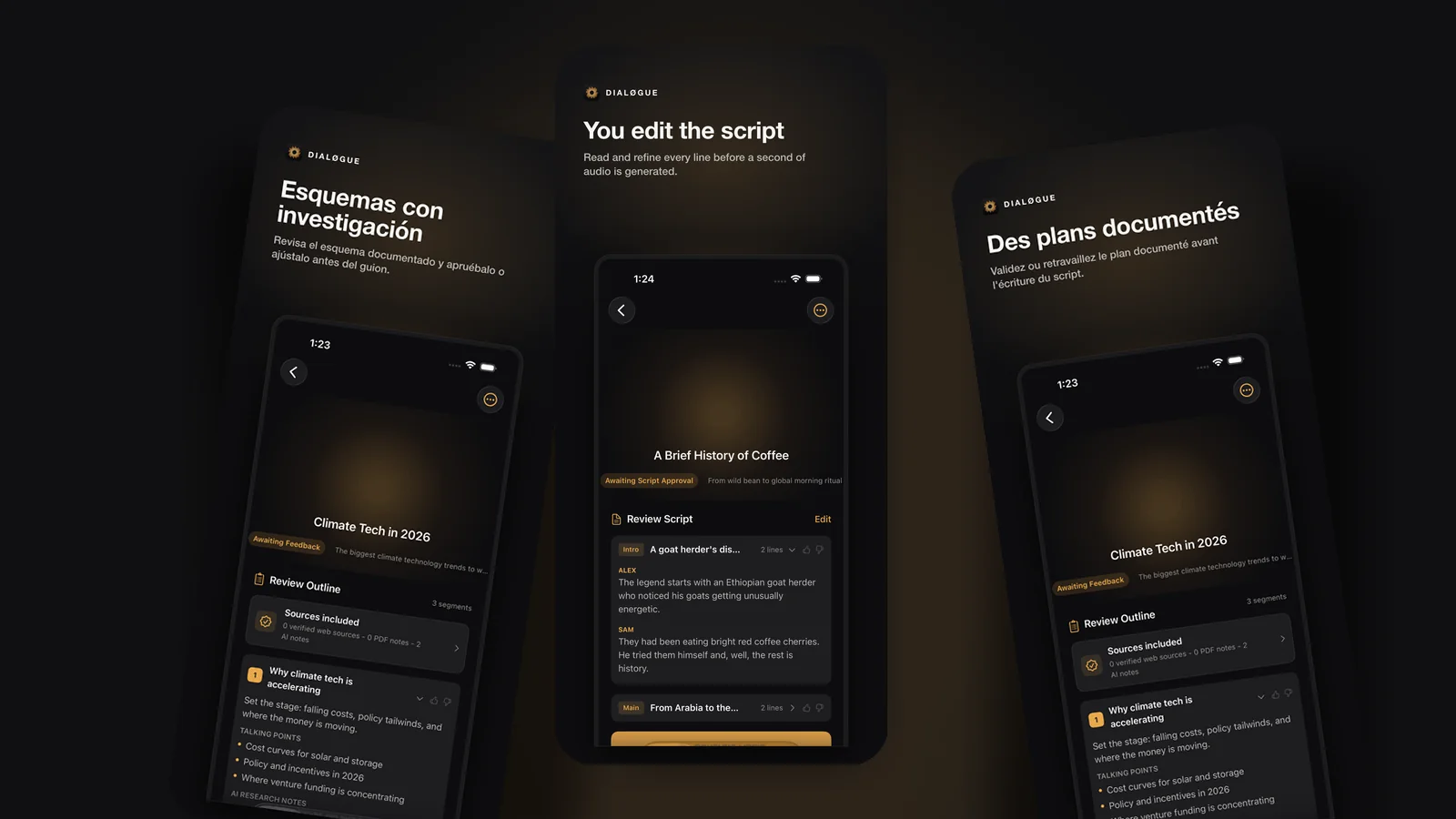
5. Review the outline carefully
This is where you catch two common failures:
- the AI keeps too much detail
- the AI becomes too generic and loses the original edge
The outline review step matters a lot more for whitepapers than for casual topics, at least in my experience. If the script still feels off after that, the script review gate becomes the second safety net before audio is finalized.
Who Is This Best For?
This workflow is especially useful for:
- marketing teams
- analysts
- consultants
- research teams
- educators
- companies with a backlog of underused PDF assets
It is a very practical way to increase the reach of content you already spent time and money producing.
When Should You Not Turn a Whitepaper into a Podcast?
I would skip this if the document depends too heavily on:
- visual data interpretation
- technical tables
- diagrams that cannot be explained simply
- very narrow specialist context
In those cases, a shorter summary episode may work better than a direct adaptation.
Why Does This Matter for Content Strategy?
Because whitepapers are expensive to make, and most teams under-distribute them.
Turning a whitepaper into a podcast helps you:
- extend shelf life
- create another distribution format
- make dense ideas more accessible
- connect research to audio-first audiences
That is especially useful if you are building a broader repurposing loop from:
- whitepaper
- blog post
- podcast
- sales asset
- newsletter summary
For the blog side of that loop, see how to turn a blog post into a podcast.
My Short Version
A whitepaper can make a very good podcast source, but only if you treat adaptation as editorial work rather than file conversion.
Keep the argument. Keep the insight. Keep the best evidence.
Lose the page-only baggage.
That is usually where the good audio version starts.
If you already have a whitepaper sitting in a content folder somewhere, upload it and test the workflow. I think this is one of those cases where seeing a dense document turn into usable audio changes how you think about the asset itself.
Written by
Chandler NguyenAd exec turned AI builder. Full-stack engineer behind DIALØGUE and other production AI platforms. 18 years in tech, 4 books, still learning.
Related Articles

Ready to create your own podcast?
Turn any topic or document into a professional podcast — with outline and script review before audio.
Create a Podcast