How to Turn a Blog Post into a Podcast Without Rewriting Everything
A practical workflow for turning existing blog posts into podcast episodes with AI. Learn what to reuse, what to adapt, and how to package written content for audio-first listeners.
I like written content. I also know most people do not want to read everything I write.
That is one reason I keep coming back to this workflow.
Yes, you can turn a blog post into a podcast without rewriting everything from scratch. In fact, a strong blog post is often one of the best starting points for an AI-generated episode because the structure, argument, and supporting detail already exist. The real job is adaptation, not reinvention.
This guide is my practical version of that process: what to reuse, what to cut, what to change for audio, and where I think teams waste time.
Why Are Blog Posts a Good Source for Podcasts?
A good blog post already contains most of what a podcast needs: a topic, a structure, examples, and a point of view.
What it usually lacks is:
- spoken pacing
- conversational transitions
- an audio-friendly opening
- the right amount of repetition for listeners
That is a much smaller gap than starting from a blank page, which is nice because blank pages are expensive.
For teams producing thought leadership, this is one of the highest-leverage content moves available. One written asset becomes:
- a blog post
- a podcast episode
- social clips or summaries
- a newsletter talking point
If you are using podcasts as part of a broader content engine, also read how to build a podcast content strategy that boosts SEO.
Which Blog Posts Adapt Best to Audio?
Not every written post becomes a strong episode. The best candidates already have a clear spoken shape.
The strongest source types are:
| Blog Post Type | Why it works in audio |
|---|---|
| How-to guides | Natural step-by-step flow |
| Case studies | Built-in narrative arc |
| Opinion pieces | Strong voice and clear point of view |
| Research summaries | Easy to convert into explanation and commentary |
| Educational explainers | Already structured for understanding |
Usually weaker candidates:
- very visual listicles
- image-heavy design roundups
- link collections with minimal original analysis
- short news blurbs with little depth
If your post already teaches, argues, compares, or explains, it is probably a good source. If it mostly depends on screenshots and formatting tricks, I would probably leave it as a blog post.
What Actually Changes When a Blog Post Becomes a Podcast?
The core idea usually stays the same. The delivery changes.
Written content and spoken content behave differently:
| Written content | Audio content |
|---|---|
| Can rely on skimming | Must work linearly |
| Can use dense paragraphs | Needs clearer pacing |
| Can point to charts and visuals | Must explain context verbally |
| Lets readers pause and re-read | Needs repetition and signposting |
| Often sounds formal | Usually benefits from conversational flow |
That means your adaptation work should focus on:
- reducing density
- improving transitions
- making examples easier to follow by ear
- replacing visual references with verbal explanation
What Is the Best Workflow for Turning a Blog Post into a Podcast?
Here is the cleanest workflow I have found for most teams:
1. Start with a Blog Post That Already Performed Well
Do not start with random content. Start with posts that already proved they are interesting.
Good selection signals:
- strong search traffic
- strong time on page
- strong social engagement
- clear conversion assistance
If people already cared enough to read it, there is a good chance they will care enough to listen. Simple, yet effective.
2. Extract the Core Listener Promise
Ask: what is the episode really helping the listener do, understand, or decide?
That promise should be simpler than the blog post itself.
For example:
- blog post: "How to build a podcast content strategy that boosts SEO and scales with AI"
- listener promise: "How to turn one podcast into a repeatable search and content engine"
This helps the episode stay focused. It also keeps the AI from wandering off into generic filler.
3. Remove Visual or Reading-Dependent Elements
Anything that only works on a screen needs to be adapted or cut.
Common examples:
- "as you can see in the chart"
- screenshot references
- overly detailed bullet inventories
- long quoted passages
Instead, convert these into short verbal summaries and comparisons.
4. Add Spoken Signposts
Listeners need more structure cues than readers do. When I forget this, the result usually sounds like a blog post being read aloud, which is not the goal.
Useful signposts:
- "Here is the main idea"
- "There are three reasons this works"
- "Now let us look at where this breaks down"
- "The practical takeaway is simple"
These are small additions, but they make the episode easier to follow.
5. Choose the Right Format
Some posts work better as explanation. Others work better as a two-host discussion.
Good format matches:
- educational post -> Educational template
- business analysis -> Business Analysis template
- trend commentary -> Tech News or analysis style
- opinionated argument -> conversational two-host discussion
If you are not sure, see which podcast template fits your content.
6. Review the Outline Before Audio
This is the most important control point. The outline is where I catch drift before the system spends time generating the full script and audio.
That matters even more when adapting an existing post because you usually want:
- the same core thesis
- the same level of nuance
- fewer tangents
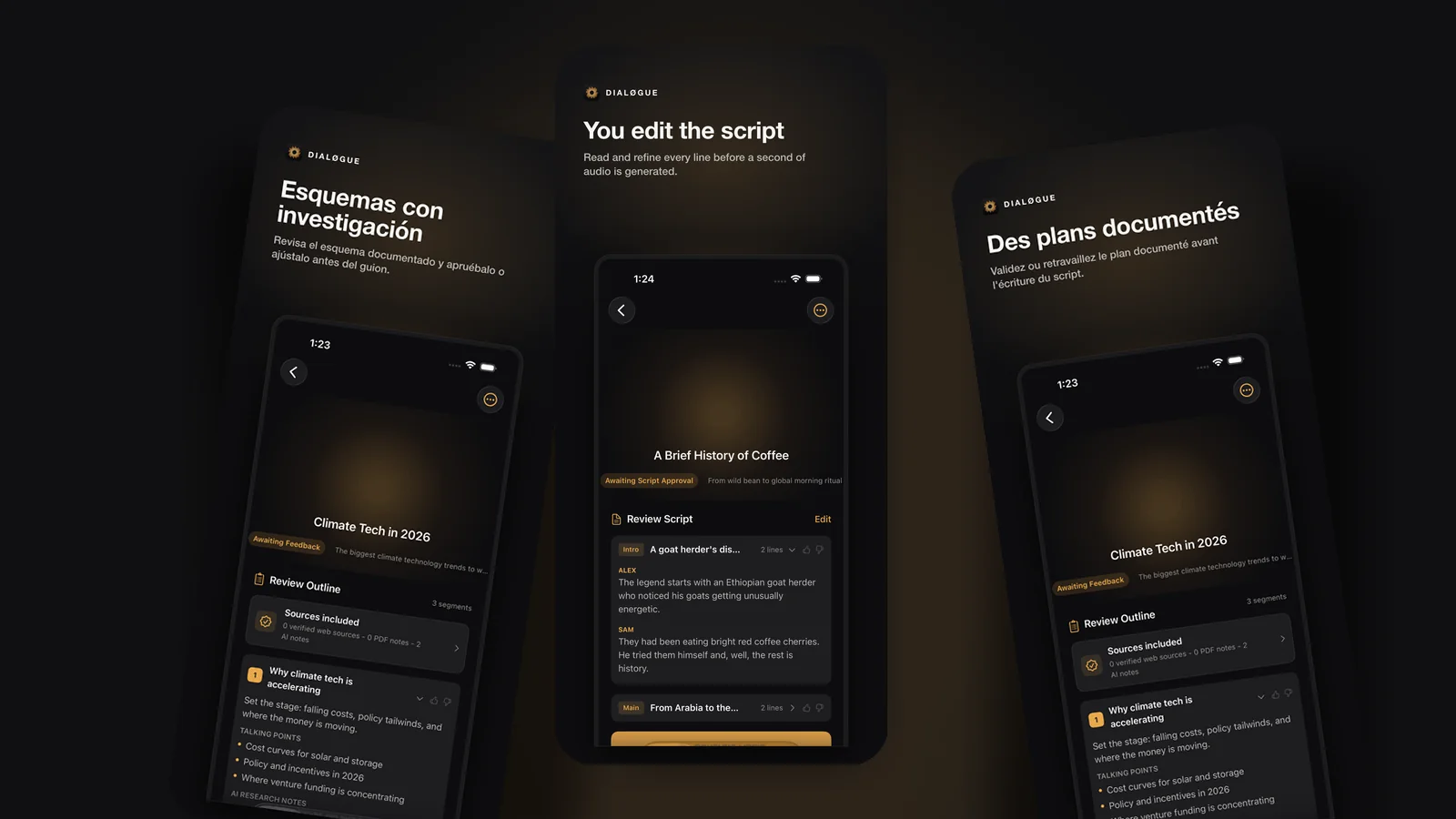
On DIALØGUE this matters even more because the workflow has two review gates:
- outline review
- script review
That second gate is useful when the idea is good but the final wording still needs adjustment before audio.
For a broader look at why this matters, read how AI podcast generation works.
Should You Paste the Blog Post or Upload It as a PDF?
There are two common approaches:
Topic-Based Adaptation
Use this when the post's core idea matters more than preserving every detail.
Best for:
- explainers
- thought leadership posts
- concise opinion pieces
Document-Based Adaptation
Use this when the exact source material matters.
Best for:
- research-heavy posts
- long-form reports
- whitepaper-style content
- posts with precise claims and examples
If you want the system to work from the written source directly, document upload is often the cleaner choice. See how to convert a PDF to a podcast.
Who Is This Workflow Best For?
This workflow is especially useful for:
- marketing teams with a blog archive
- founders publishing thought leadership
- educators repackaging lessons
- consultants converting written expertise into audio
- lean teams that want more channel reach without a full production team
It is a particularly strong fit if you already publish high-quality written content and want to extend its shelf life without multiplying production cost.
When Should You Not Turn a Blog Post into a Podcast?
I would not force audio adaptation if the original post depends heavily on:
- data visualizations
- interface walkthroughs
- image-first explanation
- very short, low-depth commentary
In those cases, the audio version may become padded or vague. It is better to start from a stronger source or combine multiple related posts into one episode theme. Less is more here.
How Does This Help SEO and Distribution?
Turning blog posts into podcasts is not just a repurposing trick. It can become a content distribution loop.
The loop looks like this:
- publish a written post
- adapt it into audio
- embed or distribute the audio
- use the podcast to reinforce the written asset
- repeat for the strongest topics
This makes one idea work across multiple discovery modes:
- search
- audio platforms
- social distribution
- newsletters
For teams thinking at the system level, the value is not one episode. The value is repeatable multi-format leverage.
Practical Checklist
Before converting a post, check:
- Is the topic still relevant?
- Does the post have a clear thesis?
- Will the argument make sense out loud?
- Are there enough examples for a conversation?
- Can you remove visual dependencies?
- Do you know the listener takeaway?
If the answer is yes to most of these, it is probably a strong candidate.
The fastest way to make a podcast from a blog post is not to start over. It is to treat your written content as source material, adapt it for listening, and use AI to handle the production work that usually makes audio too expensive or slow.
If you already have a blog archive, you are probably sitting on more podcast material than you think. If you want to test it on a real post instead of a hypothetical one, create an episode from an article that already performed well. If you try this workflow and find a better version, I would genuinely love to hear how you do it.
Written by
Chandler NguyenAd exec turned AI builder. Full-stack engineer behind DIALØGUE and other production AI platforms. 18 years in tech, 4 books, still learning.
Related Articles

Ready to create your own podcast?
Turn any topic or document into a professional podcast — with outline and script review before audio.
Create a Podcast