How to Build a Podcast Content Engine with AI
A practical system for turning one idea into a repeatable content loop using AI podcasts, written assets, Studio show workflows, and multilingual distribution.
I like the phrase "content engine" because it sounds efficient. I also dislike it because people sometimes use it to describe a pile of disconnected assets and wishful thinking.
For me, a real content engine has one important property:
it makes the next asset easier to produce than the first one.
A podcast content engine with AI is a repeatable loop where one strong idea becomes multiple connected assets without multiplying production cost linearly. That can include episodes, blog posts, document-based explainers, Studio show workflows, and multilingual versions.
The reason AI matters here is simple: it changes the economics of repetition.
What Is the Core Idea?
Do not start with channels. Start with a source idea.
That source idea can be:
- a blog post
- a whitepaper
- a market analysis
- a framework
- a recurring topic lane
If the idea is weak, the engine becomes a factory for weak content.
If the idea is strong, the engine becomes useful.
What Does a Good Engine Actually Look Like?
A practical loop often looks like this:
| Stage | Output |
|---|---|
| Source idea | Blog post, whitepaper, topic, or framework |
| Podcast adaptation | One episode or recurring series |
| Supporting written asset | SEO article, summary, or companion post |
| Distribution extension | Newsletter, internal brief, or video-ready output |
| Iteration | Reuse the strongest patterns again |
This is why I keep writing workflow posts. The useful question is not "Can AI create a thing?" The useful question is "Can this become a system?"
Why Does AI Change the Equation?
Because traditional audio production makes repetition expensive.
You pay in:
- time
- editing
- scheduling
- setup
- emotional overhead
AI does not remove all of that, but it reduces it enough that recurring production starts to feel realistic.
That is especially important when you want:
- weekly publishing
- topic experimentation
- document repurposing
- multilingual expansion
What Should the First Engine Be Built Around?
I would usually choose one of these:
1. A high-performing written asset
This is the cleanest option if you already have a blog or content archive.
Good examples:
- guide
- whitepaper
- educational post
- category explainer
From there, you can create:
- a podcast version
- follow-up articles
- shorter derivative assets
2. A recurring insight lane
This works well for:
- market commentary
- industry news
- internal briefings
- category analysis
This is where Studio show workflows become useful.
3. A business use case
For example:
- onboarding
- sales enablement
- customer education
- internal communications
These are strong because the audience and problem are already clear.
Where Does DIALØGUE Fit Uniquely?
I think DIALØGUE is more interesting as a content engine product than as a simple one-off generator because of a few workflow features:
- topic, PDF, and topic+PDF inputs
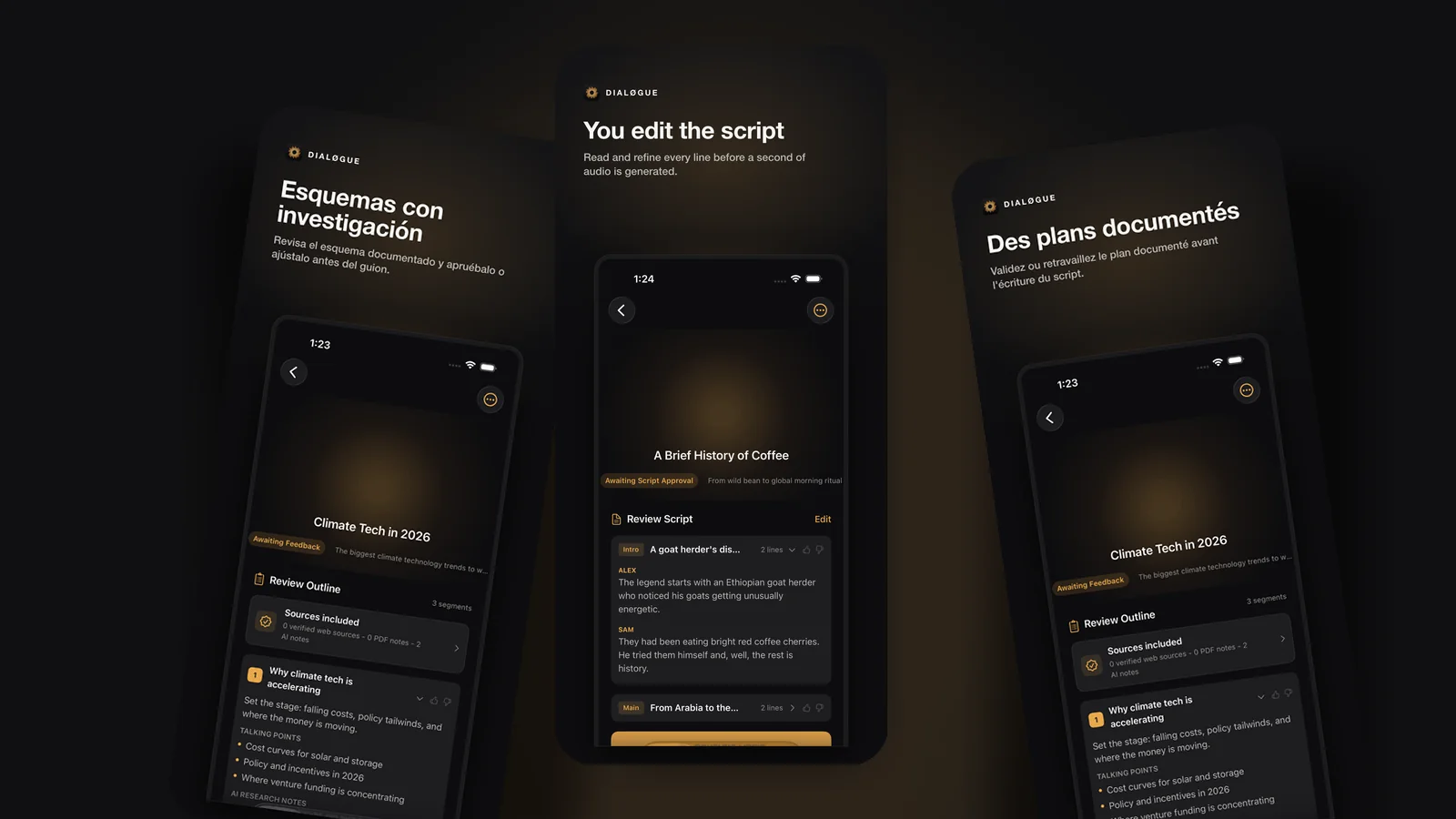
- outline review
- script review
- Studio show workflows
- multilingual generation
- Studio-based recurring production workflow
Those features matter because engines need more than output. They need control, repeatability, and flexibility.
What Is the Simplest Version to Start With?
I would start with this:
- one source idea
- one podcast adaptation
- one supporting article
- one repeatable pattern you can use again
That is enough.
You do not need an empire on day one.
What Usually Breaks the Engine?
In my experience, these are the common failures:
- trying too many channels at once
- weak source ideas
- no review checkpoints
- no repeatable format
- every episode treated like a new invention
The engine gets stronger when the number of new decisions per cycle goes down.
Who Is This Most Useful For?
This approach is especially useful for:
- marketers
- founders
- consultants
- educators
- small teams with strong expertise but limited production bandwidth
If you already have ideas and source material, the engine model helps you extract more value from them.
When Should You Not Think in Engine Terms?
I would not over-systematize too early if you have not yet found:
- a real audience
- a recurring topic lane
- a format people respond to
In that stage, experimentation matters more than efficiency.
Once you find a repeatable lane, then the engine mindset becomes powerful.
My Practical Take
The best content engine is not the one with the most assets.
It is the one where:
- one idea leads naturally to the next asset
- quality stays acceptable
- the workflow does not become exhausting
That is why I think AI matters here. It gives small teams a chance to build repeatability without building a mini production company around every episode.
If you want to build a content engine, start with one real source asset and turn it into an episode. Then ask whether that episode naturally creates the next useful piece of content. If it does, you probably have the start of a system. The closest companion workflows are how to turn a blog post into a podcast and how to turn a whitepaper into a podcast.
Written by
Chandler NguyenAd exec turned AI builder. Full-stack engineer behind DIALØGUE and other production AI platforms. 18 years in tech, 4 books, still learning.
Related Articles


Ready to create your own podcast?
Turn any topic or document into a professional podcast — with outline and script review before audio.
Create a Podcast